
In October, retail sales came in at 0.0% in monthly terms, below the 0.1% forecast, and at 1.5% year-on-year versus the expected 1.3%. At the same time, September readings were revised from –0.1% to 0.1% m/m and from 1.0% to 1.2% y/y, reflecting an acceleration in domestic demand that supports the recovery of gross domestic product (GDP). In addition, employment in Q3 rose from 0.1% to 0.2% q/q, beating the 0.1% estimate, and held at 0.6% y/y versus the preliminary 0.5%. This should boost household income overall, which in turn is likely to lift spending and inflation, supporting the single currency.
Meanwhile, European Central Bank (ECB) Executive Board member Isabel Schnabel said she is ready to run for the post of President of the ECB in less than two years, after the mandate of the current head, Christine Lagarde, expires. Other key candidates mentioned by analysts include former Dutch central bank governor Klaas Knot, Bank for International Settlements President Pablo Hernández de Cos, and Bundesbank head Joachim Nagel. The succession debate is intensifying as Vice President Luis de Guindos is set to step down in May next year. The institution faces a major reshuffle, with four of six Executive Board members due to be replaced, while maintaining the balance between large and small member states and between more “hawkish” and more “dovish” policy makers.
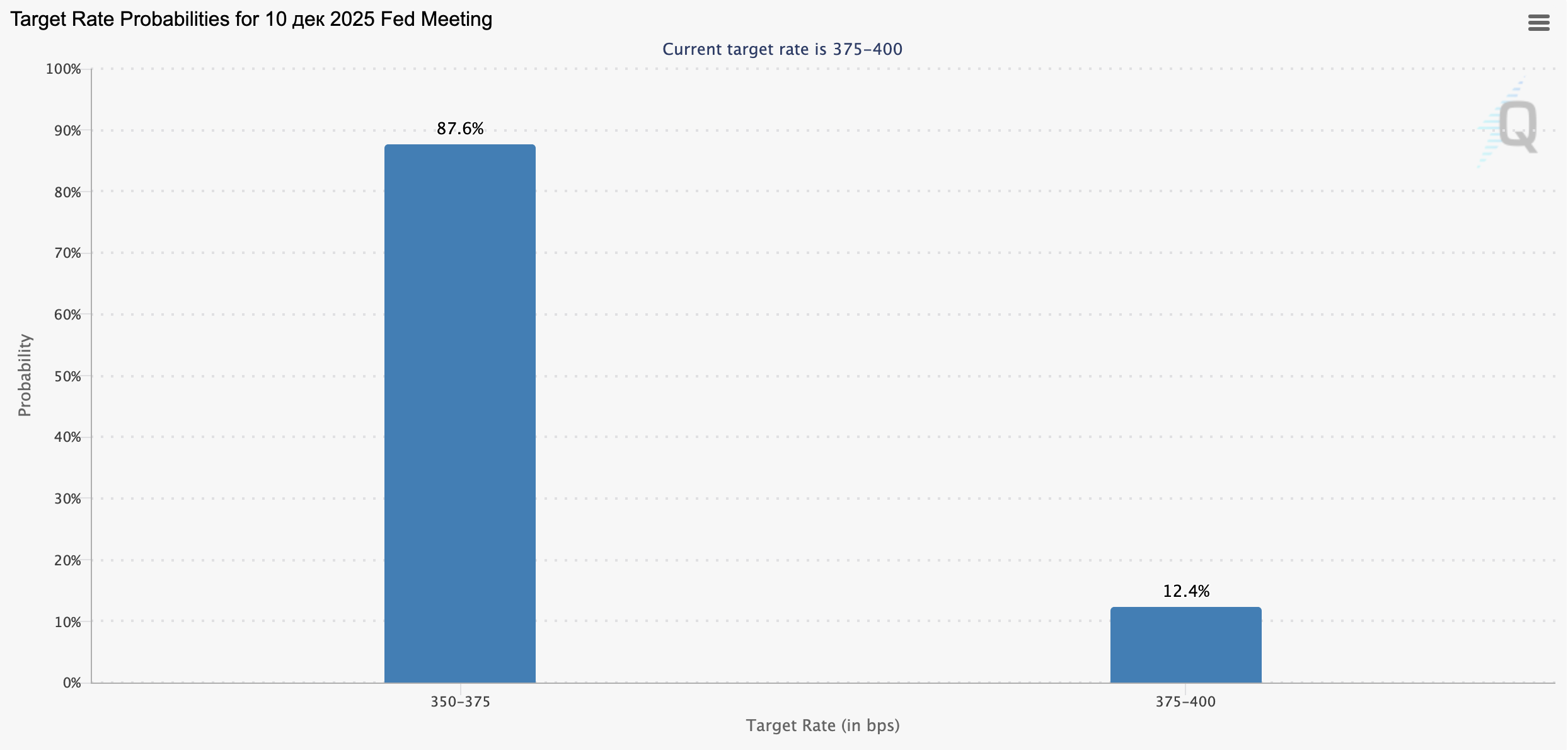
An additional source of support for EUR/USD is market expectations around today’s US Federal Reserve rate decision at 21:00 (GMT+2). According to the CME FedWatch Tool, the probability of a 25 basis point cut to 3.75% stands at 87.6%. If this scenario materialises, the US dollar is likely to come under pressure against alternative assets, including the euro. At 21:30 (GMT+2), investors will focus on the press conference by Fed Chair Jerome Powell. If he confirms a continuation of the easing cycle, the US currency is expected to extend its recent decline: over the last three weeks it has already weakened by 1.30% on the USDX, from 100.10 to 98.80, and could move toward retesting the yearly low at 96.30. Otherwise, the dollar may receive support and EUR/USD could correct lower toward 1.1550.
Support and resistance levels
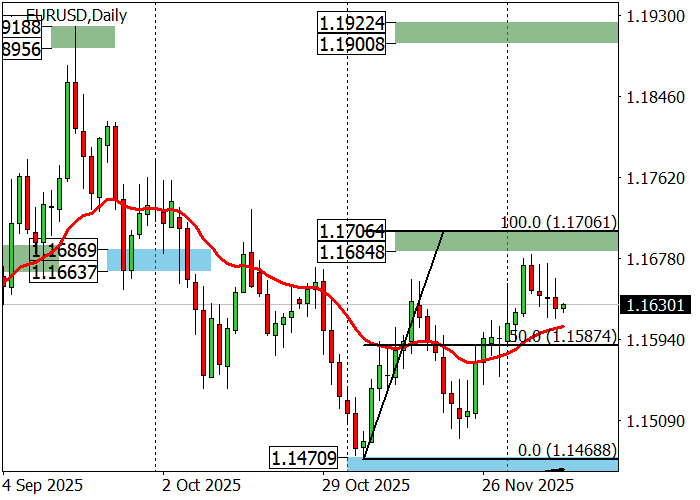
The long-term trend in the euro remains bullish. In December, the instrument renewed the November high at 1.1645 but failed to consolidate above it. If a bearish pattern forms near this resistance, short positions will become relevant with targets at 1.1550 and 1.1480. However, if the price breaks above this area during the session, the uptrend could extend toward 1.1725 and 1.1900 (the yearly high).
The medium-term trend is still bearish. In November, the pair tested the support area 2 (1.1470–1.1449) and then corrected to 1.1706–1.1684, from where short positions with targets at 1.1587 and 1.1468 remain justified. If the asset breaks above the 1.1706–1.1684 resistance zone, the trend will shift to bullish and long positions will come into focus with targets near the 1.1922–1.1900 resistance cluster.
Resistance levels: 1.1645, 1.1725, 1.1900.
Support levels: 1.1550, 1.1480, 1.1400.
EUR/USD forecast and trading scenarios
Short positions may be opened from 1.1645 with a target at 1.1550 and a stop-loss at 1.1680. Holding period: 9–12 days.
Long positions may be opened above 1.1725 with a target at 1.1900 and a stop-loss at 1.1660.
Scenario
| Timeframe | Weekly |
| Recommendation | SELL STOP |
| Entry point | 1.1645 |
| Take Profit | 1.1550 |
| Stop Loss | 1.1680 |
| Key levels | 1.1400, 1.1480, 1.1550, 1.1645, 1.1725, 1.1900 |
Alternative scenario
| Recommendation | BUY STOP |
| Entry point | 1.1725 |
| Take Profit | 1.1900 |
| Stop Loss | 1.1660 |
| Key levels | 1.1400, 1.1480, 1.1550, 1.1645, 1.1725, 1.1900 |