

One of the key components of the budget is a reform of the real estate and construction sectors. Higher rental and property purchase rates pushed the S&P Global construction PMI down from 44.1 to 39.4 points in November. All three major subsectors recorded their sharpest declines in the past five years: residential construction fell to 35.4 points, commercial construction to 43.8 points, and civil engineering to 30.0 points.
According to KPMG UK, economic growth in the United Kingdom is expected to slow to 1.0% by 2026 due to a weakening labour market, declining consumer confidence, and persistent fiscal pressure, exacerbated by frozen tax thresholds and a gradual rise in unemployment toward 5.2%. Slower wage growth (around 3.0%) and subdued consumer demand continue to limit domestic spending. Meanwhile, investment remains concentrated mainly in the energy and digital infrastructure sectors, creating risks of an uneven, K-shaped economic recovery. Monetary policy is expected to continue shifting toward further easing, with the Bank of England projected to lower rates to 3.75% by late 2025 and stabilize them near 3.25% in 2026. Inflation appears to be moving onto a more manageable trajectory and could return to target levels by spring next year, provided wage indexation does not slow this process.
Meanwhile, the US dollar is attempting to extend its upward correction after a prolonged decline, trading around 98.90 on the USDX. A heavy flow of macroeconomic data this week has shifted expectations around the upcoming Federal Reserve decision. The key indicator for the Fed was the November employment report from Automatic Data Processing (ADP), which revealed a deeper-than-expected contraction of 32K jobs in the private non-farm sector after a revised 47K increase the previous month. As a result, the CME Group FedWatch Tool now assigns an 88.2% probability to a 25-basis-point rate cut, up from 83.4% last week.
Support and Resistance Levels
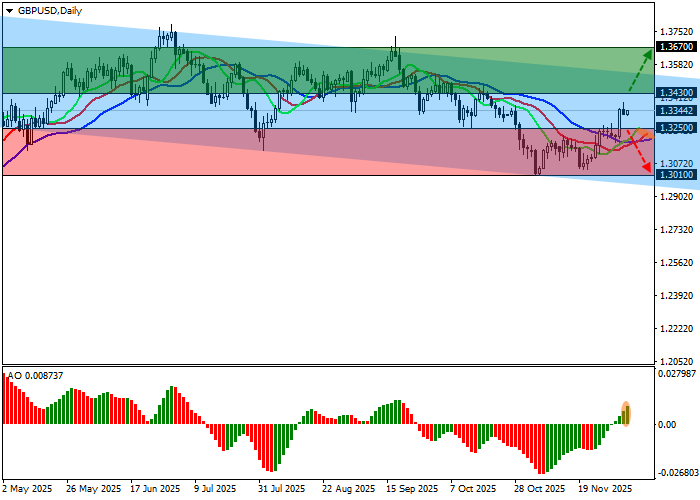
On the daily chart, the pair is undergoing a corrective pullback while remaining well above the support line of the descending channel, which spans 1.3500–1.2950.
Technical indicators have fully reversed and now signal bullish momentum: the fast EMAs of the Alligator indicator are positioned above the signal line and widening upward, while the AO histogram is forming new rising bars within the positive zone.
Support levels: 1.3250, 1.3010.
Resistance levels: 1.3430, 1.3670.
Trading Scenarios and GBP/USD Forecast
If the pair reverses higher and consolidates above the resistance level at 1.3430, long positions become relevant with a target of 1.3670 and a stop-loss at 1.3340. Estimated duration: 7 days or more.
If the decline continues and the price secures a break below the support level at 1.3250, short positions become relevant with a target of 1.3010 and a stop-loss at 1.3350.
Base Scenario
| Timeframe | Weekly |
| Recommendation | BUY STOP |
| Entry Point | 1.3430 |
| Take Profit | 1.3670 |
| Stop Loss | 1.3340 |
| Key Levels | 1.3010, 1.3250, 1.3430, 1.3670 |
Alternative Scenario
| Recommendation | SELL STOP |
| Entry Point | 1.3250 |
| Take Profit | 1.3010 |
| Stop Loss | 1.3350 |
| Key Levels | 1.3010, 1.3250, 1.3430, 1.3670 |