

For Australian investors, the key focus was inflation data published by TD Securities and the Melbourne Institute, which showed a 0.2% monthly decline—the first slowdown since August 2025, following an equivalent increase previously—while the annual figure held near 3.6%. This contrasts with official data, where the Reserve Bank of Australia’s (RBA) preferred core inflation measure (trimmed mean) accelerated from 3.3% in December to 3.4% in January. Market interpretation of these mixed signals remains cautious: on the one hand, the return to softer monthly readings may indicate easing price pressures; on the other, the annual rate remains well above the RBA’s 2.0–3.0% target range, supporting a hawkish monetary stance. According to the February meeting minutes, policymakers expect core inflation to peak at 3.7% by mid-2026 before gradually declining and returning to target only by mid-2028. The RBA, which delivered its first rate hike since 2023 to 3.85% on February 3, has signaled readiness for further tightening. Markets are already pricing in more than 40 basis points of additional tightening by year-end, with the probability of another hike in May estimated at around 80.0%. Deputy Governor Andrew Hauser confirmed that domestic capacity constraints have become a key driver of price dynamics rather than merely a risk factor, and policymakers remain prepared to take necessary action to contain inflation.
Overall, the fundamental backdrop for the Australian dollar remains favorable despite ongoing geopolitical turbulence. On February 28, tensions in the Middle East escalated sharply as US and Israeli forces carried out airstrikes on infrastructure in Tehran, Fordow, Natanz, and Isfahan. In response, Iran’s Islamic Revolutionary Guard Corps launched missile strikes targeting Israeli territory and military facilities in the region, including US bases in Bahrain, Qatar, Kuwait, the United Arab Emirates, Israel, and Cyprus. The escalation followed stalled negotiations over a renewed nuclear agreement and ongoing domestic protests in Iran triggered by economic hardship and rising consumer prices, leaving the region highly unstable and at risk of broader military confrontation.
Meanwhile, Australia’s domestic economy continues to show resilience consistent with a controlled slowdown scenario. Preliminary February PMI readings remain in expansion territory: around 51.0 points in manufacturing and 52.2 points in services. Retail turnover grew approximately 0.8% quarter-on-quarter, with electronics, construction materials, and home goods contributing the most, while the trade surplus widened to AUD 3.373 billion at the end of 2025.
US business activity data released previously also exceeded expectations: the manufacturing PMI rose from 51.2 to 51.6 points, while the ISM manufacturing index eased slightly from 52.6 to 52.4 points, still above the market forecast of 51.8 points.
Support and resistance levels
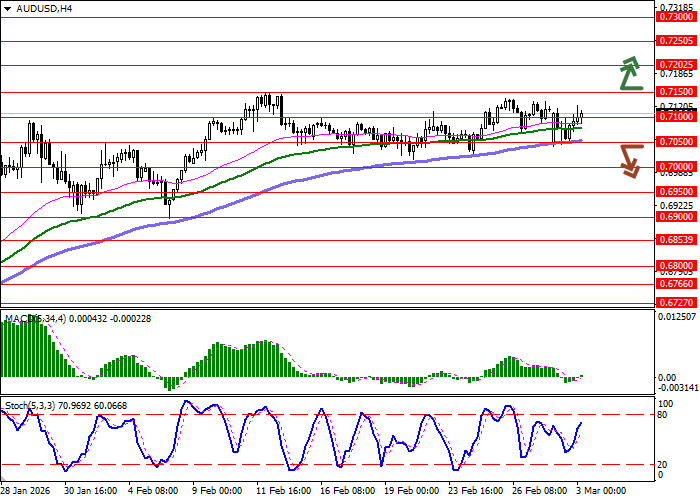
On the daily chart, Bollinger Bands are flattening, with the price range narrowing, reflecting mixed ultra-short-term trading conditions. MACD is declining, maintaining its previous sell signal below the signal line and reacting only weakly to early-week upward momentum. Stochastic is consolidating near the 80 level, still indicating significant overbought risks for the Australian dollar in the short term.
Resistance levels: 0.7150, 0.7202, 0.7250, 0.7300.
Support levels: 0.7100, 0.7050, 0.7000, 0.6950.
Trading scenarios and AUD/USD forecast
Long positions may be considered after a confirmed breakout above 0.7150, targeting 0.7250. Stop-loss: 0.7100. Time horizon: 2–3 days.
A return of bearish momentum with a breakout below 0.7050 may signal short positions toward 0.6950. Stop-loss: 0.7100.
Scenario
| Timeframe | Intraday |
| Recommendation | BUY STOP |
| Entry Point | 0.7155 |
| Take Profit | 0.7250 |
| Stop Loss | 0.7100 |
| Key Levels | 0.6950, 0.7000, 0.7050, 0.7100, 0.7150, 0.7202, 0.7250, 0.7300 |
Alternative scenario
| Recommendation | SELL STOP |
| Entry Point | 0.7045 |
| Take Profit | 0.6950 |
| Stop Loss | 0.7100 |
| Key Levels | 0.6950, 0.7000, 0.7050, 0.7100, 0.7150, 0.7202, 0.7250, 0.7300 |