
On February 28, a US–Israeli coalition carried out large-scale strikes on targets inside the Islamic Republic, involving around 200 Israeli fighter jets. According to media reports, the attacks resulted in the deaths of Ayatollah Ali Khamenei and several senior military officials. In response, Iran launched “Operation True Promise 4,” targeting more than 20 US military facilities in Bahrain, Qatar, Kuwait, and the United Arab Emirates, as well as sites in Israel, using ballistic missiles and unmanned aerial vehicles. Damage was reported to civilian infrastructure, including Dubai International Airport and the area around the Burj Al Arab complex. At the same time, reports emerged of a temporary closure of the Strait of Hormuz, through which around 20.0% of global oil supplies—approximately 17.0 million barrels per day—are transported.
Even a short-term disruption of transit pushed crude oil prices higher, widened freight spreads, and increased shipping insurance costs. Under these conditions, the Swiss franc is once again returning to the portfolios of investors seeking defensive assets during periods of heightened geopolitical instability. The escalation of the conflict creates potential for increased price volatility in the oil market, which directly affects inflation expectations and adds pressure to US Federal Reserve monetary policy. For now, the CME FedWatch Tool estimates a 95.6% probability that the benchmark interest rate will remain in the 3.50–3.75% range at the March 18 meeting. However, the outlook may change as early as May, when Federal Reserve Chair Jerome Powell is expected to step down after completing his four-year term.
Macroeconomic data from Switzerland also support the franc. Final GDP figures for the fourth quarter showed growth of 0.2% quarter-on-quarter after a –0.5% contraction in the previous period. Meanwhile, the KOF Leading Indicators Index rose to 104.2 points, well above the neutral 100 level, signaling positive expectations for business activity over the next 6–9 months. Inflation in January remained at 0.1% year-on-year, in line with the lower boundary of the Swiss National Bank’s target range of 0.0–2.0%, reinforcing expectations that interest rates will remain at zero for most of the year.
Investors are now focused on February business activity indices. The Swiss Purchasing and Supply Management Association (SVME) PMI is forecast at 50.1 points versus 48.8 previously, indicating a transition of the manufacturing sector into modest expansion. The ISM index is expected at 52.3 points versus 52.6, while the S&P Global PMI is projected at 51.2 points. Overall, these factors create a mixed fundamental backdrop for USD/CHF: in the short term, the franc is supported as a safe-haven asset, while further price dynamics will depend on the scale and duration of the military escalation in the Persian Gulf and expectations regarding the next steps by the US Federal Reserve, which remain the key driver of dollar liquidity.
Support and resistance levels
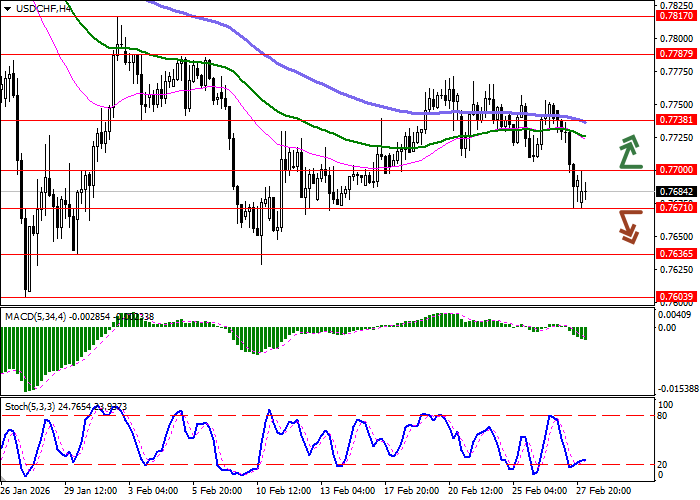
On the daily chart, Bollinger Bands show flat dynamics, with the price range narrowing and indicating mixed trading in the very short term. The MACD is turning downward, forming a new sell signal as the histogram attempts to settle below the signal line. The Stochastic oscillator is trying to reverse near the 20 level, pointing to short-term oversold conditions for the US dollar.
Resistance levels: 0.7700, 0.7738, 0.7787, 0.7817.
Support levels: 0.7671, 0.7636, 0.7603, 0.7560.
Trading scenarios and USD/CHF outlook
Short positions may be opened after a confident break below 0.7671, with a target at 0.7603. Stop-loss — 0.7700. Time horizon: 2–3 days.
A return of bullish momentum followed by a breakout above 0.7700 could signal new long positions with a target at 0.7750. Stop-loss — 0.7671.
Scenario
| Timeframe | Intraday |
| Recommendation | SELL STOP |
| Entry point | 0.7670 |
| Take Profit | 0.7603 |
| Stop Loss | 0.7700 |
| Key levels | 0.7560, 0.7603, 0.7636, 0.7671, 0.7700, 0.7738, 0.7787, 0.7817 |
Alternative scenario
| Recommendation | BUY STOP |
| Entry point | 0.7705 |
| Take Profit | 0.7750 |
| Stop Loss | 0.7671 |
| Key levels | 0.7560, 0.7603, 0.7636, 0.7671, 0.7700, 0.7738, 0.7787, 0.7817 |