

On February 28, US and Israeli armed forces carried out a series of airstrikes on Iranian infrastructure, marking a sharp escalation in the months-long standoff. At least 200 combat aircraft were reportedly involved, along with drones and naval forces, in what President Donald Trump described as an operation aimed at safeguarding national security interests. In response, Tehran launched missile strikes on Israeli territory and on strategic military facilities across the region, including US bases in Israel, Bahrain, Qatar, Kuwait, and the United Arab Emirates, as well as the British RAF Akrotiri base in Cyprus. Amid sharply rising geopolitical tensions, the US Dollar Index (DXY) climbed to 98.40 points, while the pound—traditionally sensitive to global risk aversion and uncertainty—has come under intensified selling pressure. Domestic challenges in the United Kingdom have also become more pronounced, including the Labour Party’s defeat under Prime Minister Keir Starmer in the Gorton and Denton constituencies in Manchester, where the Green Party secured victory, raising fresh questions about government stability. The monetary backdrop offers little support to sterling either: Bank of England Chief Economist Huw Pill warned that the disinflation trend is progressing more slowly than expected and that the regulator is overly focused on bringing inflation toward the 2.0% target rather than assessing future price pressures. Market expectations for the March policy meeting have shifted significantly, with only 48.0% of participants now pricing in a rate cut, compared with 84.0% previously.
Meanwhile, a recent survey by wealth and investment management firm Saltus Partners LLP showed renewed deterioration in confidence among affluent UK households, erasing gains recorded in the second half of 2025. The composite confidence index declined from 64.7 to 61.3 points, reflecting weaker assessments of both macroeconomic conditions and personal financial prospects. The survey, which included 2,000 UK residents with assets of at least 250,000 pounds, found that the share of respondents with a positive view of the national economy fell from 66.0% to 59.0%. For comparison, prior to the first budget of the Labour government in August 2024, this figure had stood at 84.0%. Nearly a quarter of respondents expressed low confidence in near-term improvement: skepticism reaches 61.0% among those aged over 65, while optimism remains relatively high at 78.0% among the 25–44 age group. Analysts attribute the renewed negative trend to a series of fiscal measures introduced by Chancellor Rachel Reeves, which have increased pressure on high-income households. More than 20.0% of respondents consider income tax rates of 40.0–45.0% excessive, while 16.0% view inheritance tax levels as too high. Confidence in personal finances also declined from 92.0% to 87.0%, returning to levels seen a year ago.
Recent UK macroeconomic data were mixed. Market participants were disappointed by the drop in the manufacturing PMI from 52.0 to 51.7 points, below neutral expectations, as well as by slower net consumer credit growth, which eased from 6.1 billion pounds to 5.9 billion pounds in January against forecasts of 6.2 billion pounds. However, the broader credit measure increased from 1.652 billion to 1.812 billion pounds. Meanwhile, US business activity data exceeded expectations: the manufacturing PMI rose from 51.2 to 51.6 points, while the ISM index edged down from 52.6 to 52.4 points, though investors had anticipated a sharper decline to 51.8.
Support and Resistance Levels
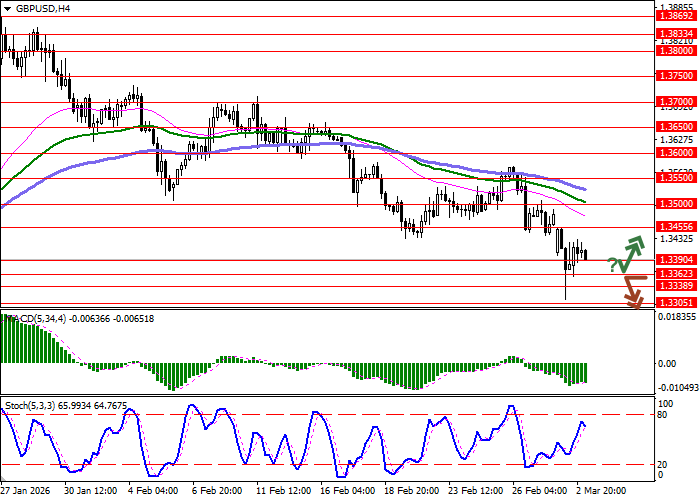
On the daily chart, Bollinger Bands show a confident downward movement, with the price range expanding to the downside, opening the way for bears toward new local lows. The MACD maintains a weak sell signal, attempting to consolidate below the zero line. The Stochastic oscillator shows similar dynamics, turning downward near the middle of its range and currently approaching the 20 level, indicating risks of short-term oversold conditions for the pound.
Resistance levels: 1.3455, 1.3500, 1.3550, 1.3600.
Support levels: 1.3390, 1.3362, 1.3338, 1.3305.
Trading Scenarios and GBP/USD Forecast
Short positions may be considered after a confident break below 1.3362, targeting 1.3305, with a stop-loss at 1.3390. Timeframe: 1–2 days.
A rebound from 1.3362 as support followed by a break above 1.3390 may signal long positions toward 1.3500, with a stop-loss at 1.3338.
Scenario
| Timeframe | Intraday |
| Recommendation | SELL |
| Entry Point | 1.3357 |
| Take Profit | 1.3305 |
| Stop Loss | 1.3390 |
| Key Levels | 1.3305, 1.3338, 1.3362, 1.3390, 1.3455, 1.3500, 1.3550, 1.3600 |
Alternative Scenario
| Recommendation | BUY STOP |
| Entry Point | 1.3395 |
| Take Profit | 1.3500 |
| Stop Loss | 1.3338 |
| Key Levels | 1.3305, 1.3338, 1.3362, 1.3390, 1.3455, 1.3500, 1.3550, 1.3600 |