

Earlier, U.S. President Donald Trump had planned to impose an additional 100% tariff on Chinese goods after Beijing announced tighter export controls on rare earth metals. Following negotiations at the Asia-Pacific Economic Cooperation (APEC) summit, the White House reduced the proposed rate to 10%, while China, in turn, postponed its export restrictions on rare earth elements until November 10, 2026.
Meanwhile, the U.S. dollar came under pressure following weak macroeconomic data released on Friday: the University of Michigan Consumer Sentiment Index fell from 53.6 to 50.3 points in November, below expectations of 53.2, while the Consumer Expectations Index dropped from 50.3 to 49.0. Markets also reacted to a sharp increase in corporate layoffs amid the ongoing government shutdown and the rise of artificial intelligence technologies. According to a report from Challenger, Grey & Christmas, announced job cuts surged from 54.06K in September to 153.07K in October — the highest level in over two decades.
The U.S. currency still finds some support from Federal Reserve Chair Jerome Powell’s recent remarks. Despite stable inflation dynamics, Powell once again cautioned markets against placing strong hopes on a potential rate cut in December, calling such a move “highly risky.” However, not all FOMC members share his view. Fed Governor Lisa Cook noted that maintaining high borrowing costs increases the risk of a sharp deterioration in the labor market, though conditions remain stable for now. At the same time, an overly aggressive rate cut could fuel inflation expectations. According to Cook, both risks should be weighed carefully when making policy decisions at the December meeting. Additionally, investors welcomed optimistic news that the record-long government shutdown may soon end, as the U.S. Senate reached a deal to extend federal funding in exchange for a future vote on expanded healthcare subsidies.
In the precious metals market, a global corrective trend continues, supported by declining investor demand for contracts. According to the Chicago Mercantile Exchange (CME Group Inc.), trading volumes have been gradually falling: on Friday, futures open interest totaled 265,119 contracts, and options — 89,975, below the October averages of 305,000 and 132,000, respectively. Moreover, on November 5, the total number of positions hit a quarterly low near 251,000.
Support and Resistance Levels
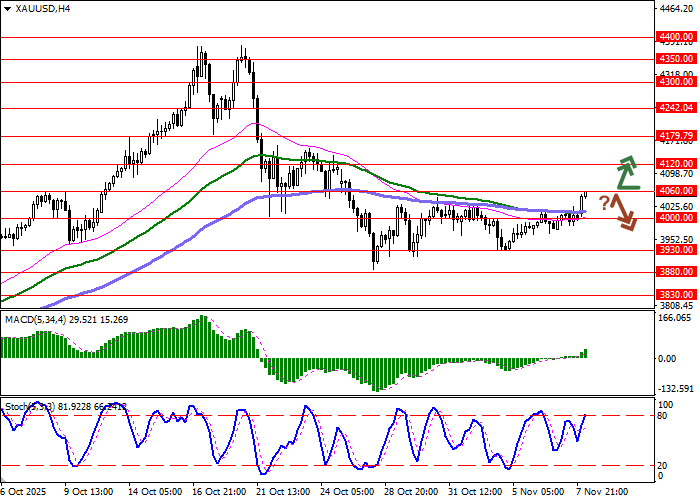
Bollinger Bands on the daily chart show signs of flattening, with the price range narrowing and reflecting mixed short-term market sentiment. The MACD indicator is turning upward, forming a fresh buy signal as the histogram moves above the signal line. The Stochastic indicator is rising sharply toward the 80 mark, signaling overbought risks for gold in the very short term.
Resistance levels: 4060.00, 4120.00, 4179.79, 4242.04.
Support levels: 4000.00, 3930.00, 3880.00, 3830.00.
Trading Scenarios and XAU/USD Forecast
Long positions may be opened after a confident breakout above 4060.00 with a target at 4179.79. Stop loss — 4000.00. Estimated holding period: 2–3 days.
A rebound from 4060.00 as resistance followed by a breakdown below 4000.00 could serve as a signal to open short positions targeting 3880.00. Stop loss — 4060.00.
Scenario
| Timeframe | Intraday |
| Recommendation | BUY STOP |
| Entry Point | 4060.00 |
| Take Profit | 4179.79 |
| Stop Loss | 4000.00 |
| Key Levels | 3830.00, 3880.00, 3930.00, 4000.00, 4060.00, 4120.00, 4179.79, 4242.04 |
Alternative Scenario
| Recommendation | SELL STOP |
| Entry Point | 4000.00 |
| Take Profit | 3880.00 |
| Stop Loss | 4060.00 |
| Key Levels | 3830.00, 3880.00, 3930.00, 4000.00, 4060.00, 4120.00, 4179.79, 4242.04 |
