

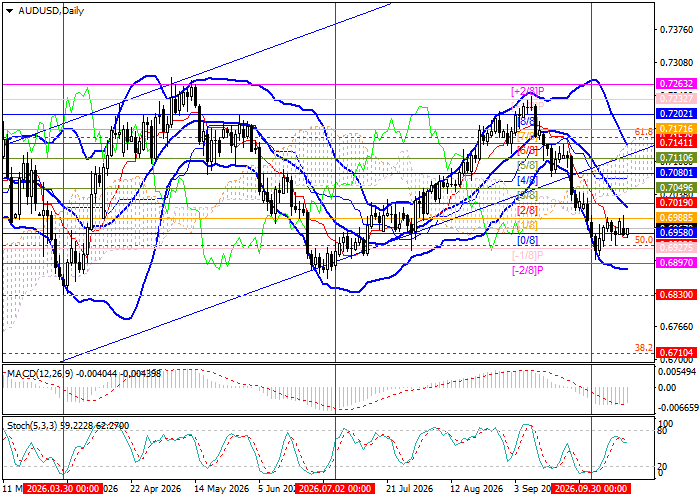
However, last week the pair recovered some of its losses amid a decline in expectations of further Federal Reserve monetary tightening in the near term and is currently trading near 0.6958 (Murray level [0/8]).
The market situation has stabilised as investors remain cautious while awaiting new signals regarding the regulator's next steps and assessing incoming macroeconomic data. In August, the Personal Consumption Expenditures (PCE) price index increased by 3.4% year-on-year instead of the expected 3.7%, while the core indicator reached 3.0% compared with forecasts of 3.3%. Meanwhile, the labour market is showing signs of cooling: in September, unemployment increased from 4.1% to 4.2%, while nonfarm payrolls rose by only 29.0K. Federal Reserve officials continue to maintain a hawkish stance, believing that another interest rate increase may be necessary this year to contain persistent inflationary pressure. Over the past few days, several policymakers have expressed similar views, including Christopher Waller, Alberto Musalem and Beth Hammack. Tomorrow, October 14, at 14:30 (GMT+2), the September Consumer Price Index will be released. According to preliminary estimates, headline inflation may accelerate from 3.4% to approximately 3.6–3.7% year-on-year, while the core indicator could increase from 2.4% to 2.5%. If the data exceed expectations, the probability of an interest rate increase at the October meeting could rise, providing additional support for the US dollar.
On the other hand, the Reserve Bank of Australia (RBA) may also tighten monetary policy further in the near future, and it remains uncertain which regulator will implement the next interest rate increase first. Today, analysts received the minutes of the RBA's September meeting, during which officials unanimously decided to raise the cash rate target to 4.60%. The document highlighted the risks of rising inflation associated with the rapid development of artificial intelligence (AI) technologies and higher energy prices caused by the Middle East conflict. At the same time, policymakers noted that an increase in the global neutral interest rate could put downward pressure on the Australian dollar if domestic monetary conditions remained unchanged. These factors may influence the regulator's future decisions and the national currency's performance.
Overall, the AUD/USD pair remains in a state of uncertainty, and its future direction will depend on new monetary policy signals. As discussed in our previous AUD/USD forecast, the stronger US dollar continues to limit the Australian currency's recovery despite the RBA's hawkish monetary policy stance.
Support and resistance levels
The trading instrument has broken below the lower boundary of the ascending channel and is approaching 0.6939 (50.0% Fibonacci retracement, Murray level [–1/8]). If the price consolidates below this level, a further decline toward 0.6830 (March low) and 0.6710 (38.2% Fibonacci retracement) is expected. However, if the pair breaks above the middle Bollinger Band at 0.7019 (Murray level [2/8]), growth may resume toward 0.7080 (Murray level [4/8]), 0.7202 (Murray level [8/8]) and 0.7263 (Murray level [+2/8]).
Technical indicators maintain a sell signal: the Bollinger Bands and Stochastic oscillator are turning downward, while the MACD histogram remains stable in negative territory.
Resistance levels: 0.7019, 0.7080, 0.7202, 0.7263.
Support levels: 0.6939, 0.6830, 0.6710.
AUD/USD trading scenarios and exchange rate forecast
Short positions may be opened below 0.6939, with targets at 0.6830 and 0.6710 and a stop-loss at 0.7010. Estimated implementation period: 5–7 days.
Long positions may be opened above 0.7019, with targets at 0.7080, 0.7202 and 0.7263 and a stop-loss at 0.6975.
Scenario
| Timeframe | Weekly |
| Recommendation | SELL STOP |
| Entry point | 0.6939 |
| Take Profit | 0.6830, 0.6710 |
| Stop Loss | 0.7010 |
| Key levels | 0.6710, 0.6830, 0.6939, 0.7019, 0.7080, 0.7202, 0.7263 |
Alternative scenario
| Recommendation | BUY STOP |
| Entry point | 0.7019 |
| Take Profit | 0.7080, 0.7202, 0.7263 |
| Stop Loss | 0.6975 |
| Key levels | 0.6710, 0.6830, 0.6939, 0.7019, 0.7080, 0.7202, 0.7263 |
