

Investors remain cautious ahead of the publication of key US macroeconomic data. Tomorrow, October 14, at 14:30 (GMT+2), the September Consumer Price Index will be released. According to preliminary forecasts, headline inflation may accelerate from 3.4% to approximately 3.6–3.7% year-on-year, while the core indicator is expected to increase from 2.4% to 2.5%. Such results could strengthen expectations of further Federal Reserve monetary tightening in the medium term, as recent comments from policymakers confirm the regulator's readiness to take additional action. Since the beginning of the month, several Federal Open Market Committee (FOMC) officials, including Christopher Waller, Alberto Musalem and Beth Hammack, have indicated that further interest rate increases may be necessary to bring inflation back toward the 2.0% target. Most market participants expect another increase in borrowing costs in December, with the probability of such a move remaining near 85.0%, according to market expectations reflected in the CME FedWatch Tool.
Meanwhile, traders will look for new signals regarding the Bank of England's monetary policy outlook in speeches by Monetary Policy Committee members Megan Greene and Huw Pill. The probability of tighter monetary conditions at the upcoming November 5 meeting is currently estimated at approximately 90.0%, while financial markets expect a series of interest rate increases in 2027 that could lift the benchmark rate from 3.75% to 4.75%. Today, the pound received additional support from the British Retail Consortium (BRC) Retail Sales Monitor, which showed that like-for-like retail sales growth accelerated from 0.5% to 1.0% year-on-year, exceeding preliminary forecasts of 0.8%. The positive data initially supported GBP/USD near 1.3240, while subsequent sterling gains brought the pair above the upper boundary of its recent trading range.
As discussed in our previous GBP/USD forecast, expectations surrounding Federal Reserve and Bank of England monetary policy continue to influence the pair, while the upcoming US inflation data may determine whether the pound can sustain its recovery.
Support and resistance levels
The trading instrument has recently been moving within the range of 1.3305–1.3183 (Murray levels [2/8]–[0/8]). If the price consolidates below 1.3183 (Murray level [0/8]), a decline toward 1.3061 (Murray level [–2/8]) and 1.2939 (Murray level [2/8], W1) may follow. However, sustained consolidation above the middle Bollinger Band at 1.3305 (Murray level [2/8]) could allow the pair to continue rising toward 1.3549 (Murray level [6/8]), 1.3671 (Murray level [8/8]) and 1.3793 (Murray level [+2/8]).
Technical indicators maintain a sell signal: the Bollinger Bands are directed downward, the MACD histogram remains stable in negative territory, while the Stochastic oscillator has exited the oversold zone but is now turning downward again.
Resistance levels: 1.3305, 1.3549, 1.3671, 1.3793.
Support levels: 1.3183, 1.3061, 1.2939.
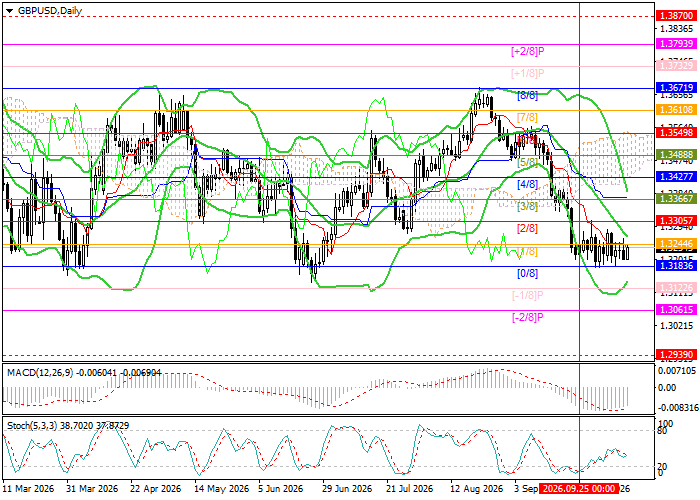
GBP/USD trading scenarios and exchange rate forecast
Short positions may be opened below 1.3183, with targets at 1.3061 and 1.2939 and a stop-loss at 1.3270. Estimated implementation period: 5–7 days.
Long positions may be considered after confirmed consolidation above 1.3305, with targets at 1.3549, 1.3671 and 1.3793 and a stop-loss at 1.3200.
Scenario
| Timeframe | Weekly |
| Recommendation | SELL STOP |
| Entry point | 1.3183 |
| Take Profit | 1.3061, 1.2939 |
| Stop Loss | 1.3270 |
| Key levels | 1.2939, 1.3061, 1.3183, 1.3305, 1.3549, 1.3671, 1.3793 |
Alternative scenario
| Recommendation | BUY STOP |
| Entry point | 1.3305 |
| Take Profit | 1.3549, 1.3671, 1.3793 |
| Stop Loss | 1.3200 |
| Key levels | 1.2939, 1.3061, 1.3183, 1.3305, 1.3549, 1.3671, 1.3793 |
