

Following earlier Japanese currency market interventions and reports of possible US support for efforts to stabilise the yen, volatility in the pair has moderated, while its direction remains dependent on expectations regarding the next steps of the Federal Reserve and the Bank of Japan. According to the latest International Monetary Fund (IMF) outlook, the Japanese regulator is expected to continue gradually raising interest rates toward a neutral level as inflationary pressures remain elevated. Meanwhile, economic growth could slow because of the ongoing energy crisis and higher import costs. Japan's gross domestic product (GDP) growth is projected to moderate to 0.7% in 2026 and remain near that level in 2027. Recent domestic statistics also reflect easing price pressures: in September, the Corporate Goods Price Index declined by 0.3% month-on-month, while annual growth slowed from 7.6% to 6.8%. Nevertheless, the indicator remains elevated, leaving the Bank of Japan with a difficult balance between supporting economic activity and containing inflation.
The US dollar initially retreated from yesterday's highs, with the USDX approaching 101.80 amid declining expectations of monetary tightening at the Federal Reserve's October meeting. However, today's September Consumer Price Index, released at 14:30 (GMT+2), showed stronger-than-expected inflation. Headline CPI increased by 0.6% month-on-month, compared with 0.4% in August, while the annual rate accelerated from 3.4% to 3.7%, exceeding forecasts of 3.6%. Core inflation, which excludes food and energy, rose from 2.4% to 2.6% year-on-year, also surpassing expectations. Following the release, the US dollar strengthened, with the USDX rising toward 102.62 and USD/JPY advancing to approximately 158.74. According to the CME FedWatch Tool, the probability of a 25-basis-point interest rate increase at the Federal Reserve's October 28 meeting rose from approximately 22.1% before the report to around 43.7%. Despite the increase in expectations of monetary tightening, keeping borrowing costs unchanged in the current 3.75–4.00% range remains a possible outcome.
As discussed in our previous USD/JPY forecast, expectations surrounding Federal Reserve monetary policy continue to support the US dollar, while possible Bank of Japan rate increases and intervention risks remain important factors limiting the pair's upside potential.
Support and resistance levels
On the daily chart, the trading instrument is correcting within a local upward trend and attempting to consolidate above the resistance line of the global descending channel with dynamic boundaries of 158.00–155.00.
Technical indicators are strengthening the buy signal: the fast EMAs of the Alligator indicator remain above the slow ones, while the AO histogram is forming corrective bars in positive territory.
Support levels: 157.60, 155.90.
Resistance levels: 158.70, 160.20.
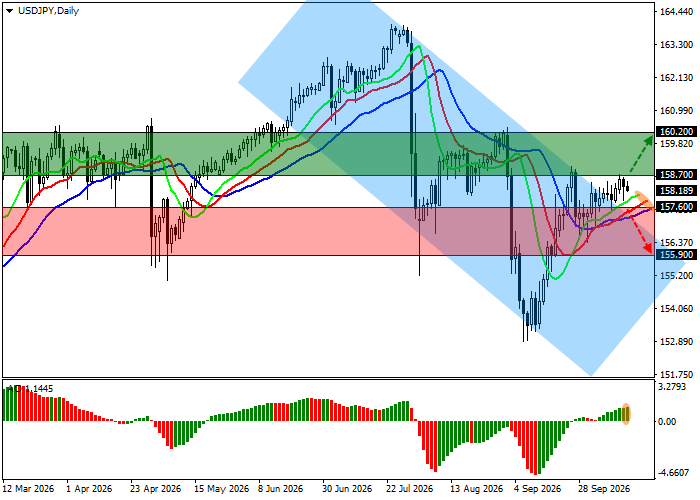
USD/JPY trading scenarios and exchange rate forecast
Long positions may be considered after the price rises and consolidates above 158.70, with a target at 160.20. Stop-loss — 157.80. Estimated implementation period: 7 days or more.
Short positions may be opened after the price declines and consolidates below 157.60, with a target at 155.90. Stop-loss — 158.50.
Scenario
| Timeframe | Weekly |
| Recommendation | BUY STOP |
| Entry point | 158.70 |
| Take Profit | 160.20 |
| Stop Loss | 157.80 |
| Key levels | 155.90, 157.60, 158.70, 160.20 |
Alternative scenario
| Recommendation | SELL STOP |
| Entry point | 157.60 |
| Take Profit | 155.90 |
| Stop Loss | 158.50 |
| Key levels | 155.90, 157.60, 158.70, 160.20 |
