

Investors are closely following negotiations between Iran and Oman over a mechanism for safe navigation through the Strait of Hormuz. Oman has acted as an intermediary in the broader diplomatic process involving Tehran and Washington, while discussions between the two coastal states have focused specifically on establishing a safe shipping route through the strategic waterway.
According to the Iranian Ministry of Foreign Affairs, consultations with Oman were still ongoing as of August 10 and no final arrangement had been announced. Tehran has linked broader security in the strait to an end to what it describes as US military pressure, the naval blockade and other actions against Iran. As a result, expectations for a rapid normalization of shipping remain uncertain.
The unresolved situation continues to support a geopolitical risk premium in crude oil. The Strait of Hormuz remains one of the world's most important energy transit routes, and disruptions to shipping through the area have already had a significant impact on global oil flows. The US Energy Information Administration estimates that around 14.6 million barrels per day of crude oil, condensate and petroleum products moved through the strait in the first quarter of 2026, down sharply from more than 20 million barrels per day during most of 2025.
The same geopolitical risks were also discussed in FORECK.INFO's recent oil and Iran outlook, as markets continued to reprice the potential consequences of changes in shipping access through Hormuz.
US inventory data will provide another short-term catalyst for oil prices. The next EIA Weekly Petroleum Status Report is scheduled for Wednesday, August 12, at 10:30 a.m. ET. In the previous report, covering the week ended July 31, US commercial crude oil inventories increased by approximately 2.5 million barrels to 407.0 million barrels. Despite the increase, inventories remained about 6% below the five-year average for this time of year.
The broader supply outlook remains mixed. In its August Short-Term Energy Outlook, the EIA estimated that global oil inventories would decline by an average of 2.2 million barrels per day in the third quarter of 2026. However, the agency expects rising production and recovering trade flows to shift the market back toward oversupply later in the year, creating renewed downward pressure on crude prices.
CME Group data continue to show substantial activity in WTI futures and options as traders manage exposure to geopolitical and supply risks. Given the uncertainty surrounding Hormuz and upcoming US inventory data, positioning figures alone do not provide a reliable indication that price volatility will remain limited.
Support and Resistance Levels
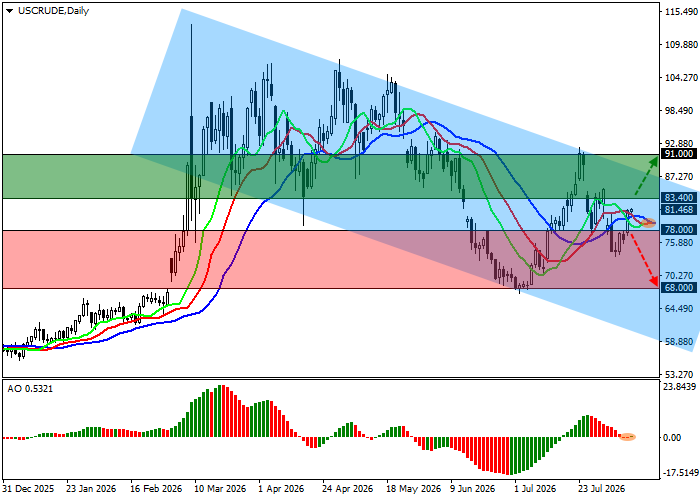
On the daily chart, WTI Crude Oil is correcting well below the resistance line of a broader descending channel with approximate boundaries at 87.30 and 58.80.
Technical indicators suggest that bearish momentum is weakening and a bullish signal could develop. The faster moving averages of the Alligator indicator remain below the slower line, while the Awesome Oscillator histogram is forming corrective bars and approaching the zero level.
Resistance levels: 83.40, 91.00.
Support levels: 78.00, 68.00.
WTI Crude Oil Trading Scenarios and Forecast
Long positions may be considered after a rise and consolidation above 83.40, with a target at 91.00 and a stop-loss at 79.00. Time horizon: seven days or more.
Short positions may be considered after a decline and consolidation below 78.00, with a target at 68.00 and a stop-loss at 82.00.
