

Investors and forex traders are focused on the outcome of today's Reserve Bank of Australia (RBA) meeting. The central bank raised the cash rate target by 25 basis points from 4.35% to 4.60%, broadly in line with market expectations, while leaving the door open to further monetary tightening if inflation remains elevated.
According to the Reserve Bank of Australia, some of the upside risks to inflation identified earlier in the year are now materialising. The regulator highlighted significantly higher global energy prices caused by the continuing Middle East conflict, strong global demand for technology-related goods associated with artificial intelligence and persistent domestic capacity pressures.
Australian inflation remains above the central bank's target range. According to the Australian Bureau of Statistics, the Consumer Price Index increased 3.8% year-on-year in June, while trimmed mean inflation stood at 3.6%, compared with the RBA's 2.0–3.0% target range.
The September decision marks the fourth rate increase this year, bringing the cumulative tightening in 2026 to 100 basis points. Although policymakers reiterated their commitment to returning inflation sustainably to target, the Australian dollar weakened following the announcement as investors interpreted the accompanying communication as less aggressive than some had expected.
Higher borrowing costs are also increasing concerns about the outlook for the domestic economy. Australian gross domestic product expanded by only 0.4% in the June quarter and by 2.1% year-on-year, slowing from 2.5% annual growth in the March quarter. Household spending remains cautious, while higher interest rates and falling housing prices may continue to constrain domestic demand.
As discussed in our previous AUD/USD outlook, Australian monetary policy and persistent inflation had previously supported expectations for further gains in the national currency. Since then, however, stronger US data, rising Treasury yields and renewed demand for the US dollar have reversed the pair's momentum.
Meanwhile, economic activity in the United States remains strong. In September, the S&P Global Manufacturing PMI rose from 53.9 to 57.0, the Services PMI increased from 56.5 to 58.7, and the Composite PMI advanced from 56.0 to 58.4, its highest level in more than five years.
The figures point to resilient economic growth but also stronger inflationary pressure, allowing the Federal Reserve to remain focused on price stability following its September rate increase.
Attention is now shifting to the September US labour market report due on Friday. If employment growth remains solid and unemployment stays relatively stable, expectations of additional Federal Reserve tightening could increase further.
According to current market pricing, investors assign roughly a 70% probability to another 25-basis-point Fed rate increase at the October meeting. The probability that rates will be higher by the December meeting is currently close to 96%.
The combination of resilient US economic data, elevated Treasury yields and expectations of continued Federal Reserve tightening therefore continues to support the US dollar, while concerns about the effect of higher borrowing costs on Australian growth remain a headwind for AUD/USD.
Support and resistance levels
The trading instrument has broken below the lower boundary of the previous ascending channel and consolidated below 0.7019 (Murray level [3/8]). This setup allows the downward movement to continue toward 0.6897 (Murray level [1/8]) and 0.6835 (Murray level [0/8]).
However, if the pair breaks above the middle Bollinger Band around 0.7120, the price may return to the previous trading range and target 0.7202 (Murray level [6/8]), 0.7263 (Murray level [7/8]) and 0.7324 (Murray level [8/8]).
Technical indicators continue to generate a sell signal: the Bollinger Bands are turning downward and the MACD histogram is expanding in negative territory. At the same time, the Stochastic oscillator has reached the oversold zone, leaving room for a limited upward correction.
Resistance levels: 0.7120, 0.7202, 0.7263, 0.7324.
Support levels: 0.6897, 0.6835.
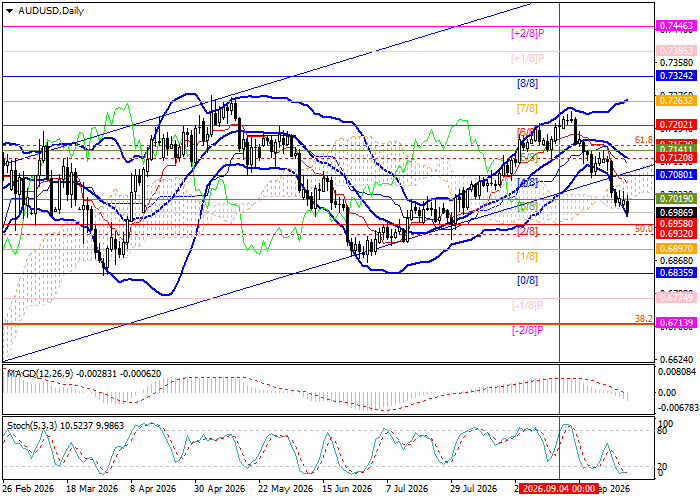
AUD/USD trading scenarios and exchange rate forecast
Short positions may be opened from 0.6975 with targets at 0.6897 and 0.6835 and a stop-loss at 0.7030. Estimated implementation period: 5–7 days.
Long positions may be opened above 0.7120 with targets at 0.7202, 0.7263 and 0.7324 and a stop-loss at 0.7070.
Scenario
| Timeframe | Weekly |
| Recommendation | SELL STOP |
| Entry point | 0.6975 |
| Take Profit | 0.6897, 0.6835 |
| Stop Loss | 0.7030 |
| Key levels | 0.6835, 0.6897, 0.7120, 0.7202, 0.7263, 0.7324 |
Alternative scenario
| Recommendation | BUY STOP |
| Entry point | 0.7120 |
| Take Profit | 0.7202, 0.7263, 0.7324 |
| Stop Loss | 0.7070 |
| Key levels | 0.6835, 0.6897, 0.7120, 0.7202, 0.7263, 0.7324 |
