
According to US Vice President J.D. Vance, no agreement was reached after 21 hours of talks with the Iranian side. While consensus was reportedly achieved on most secondary issues, key matters related to the nuclear program remained unresolved, as representatives of the Islamic Republic stated that they do not intend to abandon work in this area. In addition, according to sources cited by The New York Times, the White House demanded that Iran immediately reopen the Strait of Hormuz for unrestricted shipping, but Tehran said it would only do so after a final peace plan is concluded. Meanwhile, according to statements by President Donald Trump published on Truth Social, US naval forces are planning to intercept vessels passing through the strait and inspect tankers that, according to Washington, may have made payments through the Tehran Toll Boot system for passage along this route. The statements also emphasized the involvement of other countries in these operations, while US actions were presented as an effort to protect global trade and ensure the uninterrupted flow of cargo to China, Japan, South Korea, and EU countries. At the same time, Trump also commented on talks with the Iranian delegation in Islamabad, saying that partial agreements had been reached, whereas Iran’s Foreign Ministry gave a more restrained assessment, pointing to a lack of progress on core issues and an atmosphere of mutual distrust. It is already known that the main sticking points include the full restoration of shipping through the Strait of Hormuz without additional transit fees, as well as further steps regarding 400.0 kilograms of highly enriched uranium and Iran’s demand for the unfreezing of $27.0 billion in blocked assets. Overall, the continuing uncertainty surrounding maritime routes and the diplomatic process is increasing risks for global energy stability and supply chains.
As for local factors that may affect the market, tomorrow at 16:30 (GMT+2) the American Petroleum Institute (API) may again report an increase in crude oil inventories after last week’s rise of 3.719 million barrels, while a similar report from the US Energy Information Administration (EIA) may show a gain of 1.000 million barrels following a previous increase of 3.081 million barrels.
Meanwhile, major trading venues continue to report stable activity levels. The Chicago Mercantile Exchange (CME), for example, recorded 1.01 million futures positions traded on April 10, which is an average level comparable to readings seen at the beginning of the month, while the number of options contracts remains near 0.259 million. Naturally, if these figures continue to rise gradually, prices could resume their upward movement, allowing investors to hold long positions for longer.
Support and resistance levels
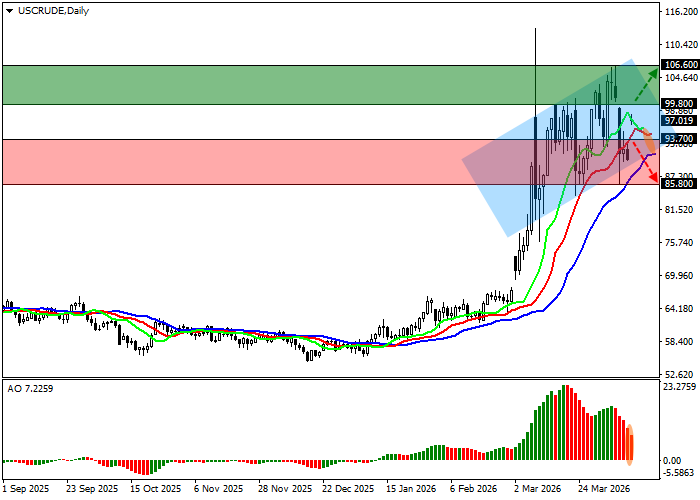
On the daily chart, the instrument is trading slightly above the recent intermediate support level of 95.00.
Technical indicators have long since turned upward and continue to maintain a stable buy signal: the fast EMAs on the Alligator indicator remain above the signal line, while the AO histogram is forming new corrective bars not far from the zero line.
Support levels: 93.70, 85.80.
Resistance levels: 99.80, 106.60.
WTI Crude Oil Trading Scenarios and Forecast
Long positions may be considered after the price consolidates above 99.80 with a target at 106.60. Stop-loss: 97.00. Timeframe: 7 days or longer.
Short positions may be considered after the price consolidates below 93.70 with a target at 85.80. Stop-loss: 96.00.
Scenario
| Timeframe | Weekly |
| Recommendation | BUY STOP |
| Entry Point | 99.80 |
| Take Profit | 106.60 |
| Stop Loss | 97.00 |
| Key Levels | 85.80, 93.70, 99.80, 106.60 |
Alternative Scenario
| Recommendation | SELL STOP |
| Entry Point | 93.70 |
| Take Profit | 85.80 |
| Stop Loss | 96.00 |
| Key Levels | 85.80, 93.70, 99.80, 106.60 |
