

New Zealand’s seasonally adjusted unemployment rate rose to 5.6% in the second quarter, up from 5.3% in the March quarter. The number of unemployed people increased to around 171.0 thousand, while total employment nevertheless rose from approximately 2.889 million to 2.905 million.
The employment rate remained broadly stable, suggesting that the latest figures are not simply a story of collapsing job creation. Still, the rise in unemployment points to continued spare capacity in the labour market and confirms that businesses remain cautious about hiring. If this trend persists, it could weigh on household spending and slow the broader economic recovery.
The Reserve Bank of New Zealand had already warned that subdued activity, weak business profitability and slower hiring could keep unemployment elevated for an extended period. At the same time, inflation remains above the central bank’s target range, limiting how much support monetary policy can provide to the economy.
The US dollar, which remains the other key driver of NZD/USD, is trading with a modest positive bias near the 99.80–100.00 area on the USDX. Markets continue to follow developments in the Persian Gulf, where negotiations involving Iran and Oman have raised hopes of easing restrictions on traffic through the Strait of Hormuz.
However, the diplomatic picture remains complicated. Iranian officials have reported progress in talks with Oman but denied holding direct negotiations with Washington in recent days. Several important details of a potential arrangement for the strait also remain unresolved, preventing investors from treating an agreement as final.
The changing geopolitical backdrop has already produced sharp swings in both oil and the dollar, as discussed in FORECK.INFO’s recent review of Fed and Iran risks.
Monetary policy is becoming increasingly important for the US currency. Federal Reserve Governor Lisa Cook said she was open to raising short-term interest rates if necessary because inflation remains too high. San Francisco Fed President Mary Daly, meanwhile, said she fully supported the latest decision to keep borrowing costs unchanged and argued that policymakers need more data before the September meeting.
The comments underline the lack of a clear consensus inside the Federal Reserve. A September rate increase remains possible, but expectations are highly sensitive to incoming inflation and labour-market data, making precise market-implied probabilities particularly volatile.
Support and Resistance Levels
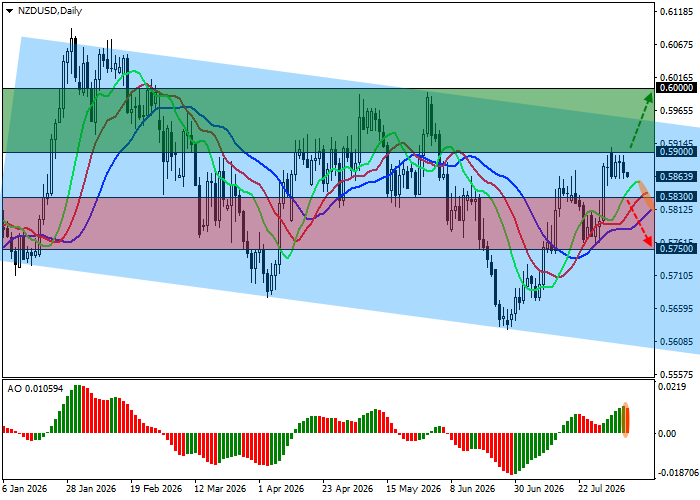
NZD/USD is moving higher within a local descending channel with dynamic boundaries around 0.5940–0.5600, but the pair remains below the channel’s resistance line.
Technical indicators maintain an unstable buy signal. The fast EMAs of the Alligator indicator are positioned slightly above the slower lines, while the Awesome Oscillator histogram is forming corrective bars in positive territory.
Resistance levels: 0.5900, 0.6000.
Support levels: 0.5830, 0.5750.
NZD/USD Trading Scenarios and Price Forecast
Long positions may be considered after the price rises and consolidates above 0.5900, with a target at 0.6000 and a stop-loss at 0.5830. Time horizon: seven days or more.
Short positions may be considered after the price falls and consolidates below 0.5830, with a target at 0.5750 and a stop-loss at 0.5880.
