

The yen remains relatively stable as investors assess the Bank of Japan's policy outlook following its October 30 decision to keep rates at 1.25%. On Friday, former BoJ chief economist Seisaku Kameda told Reuters that he expected a December increase to 1.50%. In his view, the main obstacle would be a prolonged decline in equity markets following the sharp selloff in artificial intelligence (AI) stocks late last week. If volatility persists ahead of the December 17–18 meeting, the central bank could postpone the increase. Kameda expects further tightening to bring rates to 2.00% in 2027. He also said consumer inflation was likely to accelerate in the coming months as businesses passed higher costs on to consumers, making further rate increases necessary in his assessment.
The US dollar has rebounded from its recent low, with the US Dollar Index (USDX) trading around 102.00 amid concerns over a possible resumption of military operations in the Middle East. Last week's technology-sector selloff also encouraged demand for safe-haven assets after the Democratic victory in the congressional elections raised concerns about the outlook for multibillion-dollar AI investment. Meanwhile, CME FedWatch pricing indicated roughly a 20% probability that the Federal Reserve would leave interest rates unchanged at its December 9 meeting, supporting expectations of further tightening. Friday's comments from New York Fed President John Williams and St. Louis Fed President Alberto Musalem also kept inflation in focus. Both stressed the importance of bringing elevated inflation back towards the Fed's 2.0% target. The role of relative monetary policy expectations was also discussed in our previous USD/JPY forecast.
Support and Resistance Levels
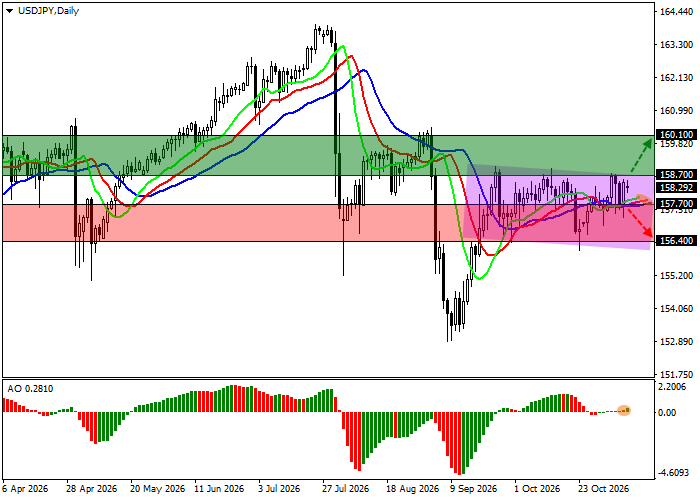
On the daily chart, the pair is moving higher within its broader sideways range, approaching the resistance line of a descending channel with boundaries at 158.70–156.20.
Technical indicators offer mixed signals. The Alligator indicator's faster exponential moving averages (EMAs) remain below the slower ones, while the Awesome Oscillator (AO) histogram is forming corrective bars in positive territory.
Support levels: 157.70, 156.40.
Resistance levels: 158.70, 160.10.


Trading Scenarios
Long positions may be considered after the price rises and consolidates above 158.70, targeting 160.10 with a stop-loss at 157.70. The estimated holding period is seven days or more.
Short positions may be considered after the price declines and consolidates below 157.70, targeting 156.40 with a stop-loss at 158.50.
Scenario
| Timeframe | Weekly |
| Recommendation | BUY STOP |
| Entry Point | 158.70 |
| Take Profit | 160.10 |
| Stop Loss | 157.70 |
| Key Levels | 156.40, 157.70, 158.70, 160.10 |
Alternative Scenario
| Recommendation | SELL STOP |
| Entry Point | 157.70 |
| Take Profit | 156.40 |
| Stop Loss | 158.50 |
| Key Levels | 156.40, 157.70, 158.70, 160.10 |
