

Investors had been hoping for progress toward an arrangement between the United States and Iran that could ease restrictions on shipping through the Strait of Hormuz, but no comprehensive agreement followed. Tehran has instead maintained additional conditions for a broader reopening of the waterway, including sanctions-related demands and compensation. Recent maritime developments have added to uncertainty: the UKMTO Joint Maritime Information Center continues to assess a substantial threat to merchant shipping around Bab el-Mandeb following renewed Houthi attacks and threats, while US forces continue enforcing the blockade of Iranian ports.
Further escalation could prolong restrictions affecting strategically important maritime energy routes and maintain upward pressure on global energy prices. Persistent energy inflation could, in turn, limit the Federal Reserve's room to adopt a less restrictive monetary stance despite signs of cooling in the US labour market. In its July 29 statement, the Federal Open Market Committee said inflation remained elevated relative to its 2% objective, partly because of supply shocks affecting sectors including energy, and reiterated its commitment to restoring price stability.
US inflation data published on August 12 showed some moderation in price pressures. According to the US Bureau of Labor Statistics, the Consumer Price Index rose 0.1% in July after falling 0.4% in June, while annual headline inflation slowed from 3.5% to 3.4%. Core CPI, which excludes food and energy, increased 0.2% month over month and slowed from 2.6% to 2.5% year over year. Although both annual readings eased, inflation remains above the Federal Reserve's 2% longer-term objective.
Downside pressure on EUR/USD is partly limited by macroeconomic data from Germany, the euro area's largest economy. According to preliminary data from the Federal Statistical Office, both Germany's Consumer Price Index and Harmonised Index of Consumer Prices rose 2.8% year over year in July. Persistently elevated inflation could keep the European Central Bank cautious about further monetary easing. The broader balance between eurozone inflation and US monetary policy was also discussed in FORECK.INFO's recent EUR/USD outlook.
Support and Resistance Levels
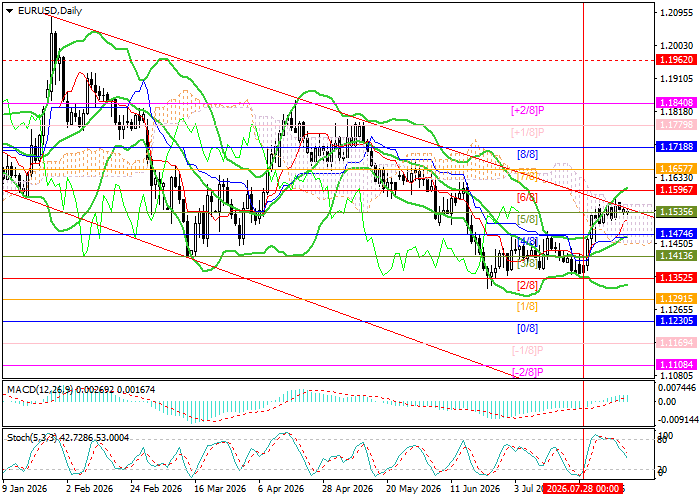
The pair is attempting to break out of the descending channel through its upper boundary. A breakout above 1.1596, the Murrey [6/8] level, could allow the positive momentum to continue toward 1.1718, the Murrey [8/8] level, 1.1840, the Murrey [+2/8] level, and 1.1962, the weekly Murrey [6/8] level. However, consolidation below the middle Bollinger Band near 1.1474, the Murrey [4/8] level, could lead to renewed downside pressure toward 1.1352, the Murrey [2/8] level, and 1.1230, the Murrey [0/8] level.
Technical indicators provide mixed signals: the Bollinger Bands are pointing higher, the MACD histogram has moved into positive territory, while the Stochastic Oscillator has turned lower from the overbought zone.
Resistance levels: 1.1596, 1.1718, 1.1840, 1.1962.
Support levels: 1.1474, 1.1352, 1.1230.
EUR/USD Trading Scenarios and Forecast
Short positions may be considered below 1.1474, with targets at 1.1352 and 1.1230 and a stop-loss at 1.1555. Time horizon: 5–7 days.
Long positions may be considered above 1.1596, with targets at 1.1718, 1.1840 and 1.1962 and a stop-loss at 1.1520.
