

Since taking office on July 20, Burnham has reiterated his commitment to fiscal discipline while introducing several measures aimed at reducing costs for households and businesses. The government has announced the removal of VAT from domestic electricity bills from October 1, a £2 cap on participating bus fares from January 2027 and an additional 20% reduction in business rates for pubs, social clubs and live music venues from the 2027/28 financial year. The political transition and its earlier impact on sterling were discussed in FORECK.INFO's previous GBP/USD forecast.
The government has also signalled that broader business-rate reform will be considered at the October Budget. In its official announcement, Downing Street said the measures form part of a wider effort to reduce costs for businesses while remaining consistent with the government's fiscal rules. Burnham has also indicated that further support could be considered despite the difficult fiscal outlook.
Attention will now turn to UK economic data. The Office for National Statistics will publish its first estimate of second-quarter GDP on August 13 at 07:00 BST. Market forecasts broadly point to growth slowing from 0.6% to around 0.4% quarter over quarter, while annual growth is expected to be close to 1.1%.
The figures could influence expectations for the Bank of England's next monetary-policy decision. The Bank kept its policy rate unchanged at 3.75% in July, noting that inflation had eased but that high and volatile energy prices continued to create upside risks. Stronger-than-expected economic growth could therefore keep expectations of another rate increase alive, while a weaker reading could reduce those expectations and limit further gains in sterling.
Geopolitical uncertainty in the Persian Gulf could also restrain GBP/USD. No final arrangement has yet been reached over shipping through the Strait of Hormuz, although Iran and Oman continue consultations on a possible framework. A renewed escalation could prolong disruptions to one of the world's most important energy routes, keeping oil and gas prices elevated and adding to global inflation risks. Such a scenario could support a more hawkish Federal Reserve stance if higher energy costs begin to feed into US inflation, providing support for the dollar.
Support and Resistance Levels
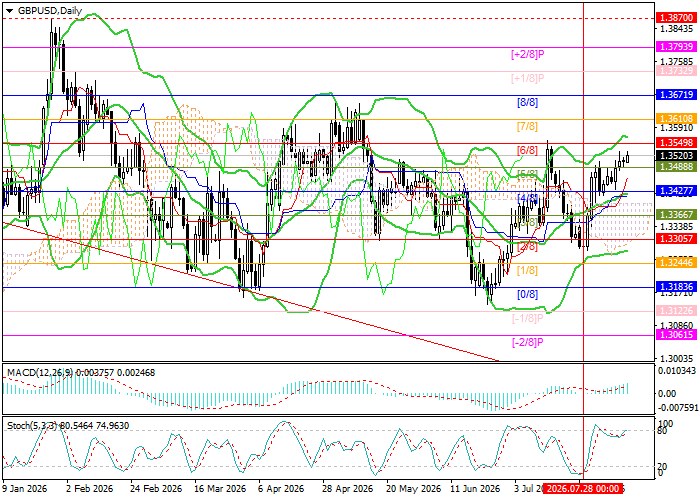
GBP/USD is trading within a broad sideways range of 1.3183–1.3671, corresponding to the Murrey [0/8]–[8/8] levels, and is approaching 1.3549, the Murrey [6/8] level. A breakout above this area could allow the advance to continue toward 1.3671, the Murrey [8/8] level, followed by 1.3793, the Murrey [+2/8] level, and 1.3870, the yearly high. Conversely, consolidation below the middle Bollinger Band at 1.3427, the Murrey [4/8] level, could lead to renewed downside pressure toward 1.3305, the Murrey [2/8] level and lower Bollinger Band, 1.3183, the Murrey [0/8] level, and 1.3061, the Murrey [–2/8] level.
Technical indicators continue to provide a bullish signal: the Bollinger Bands are turning higher and the MACD histogram is expanding in positive territory. However, the Stochastic Oscillator has reached the overbought zone, which leaves room for a limited correction.
Resistance levels: 1.3549, 1.3671, 1.3793, 1.3870.
Support levels: 1.3427, 1.3305, 1.3183, 1.3061.
GBP/USD Trading Scenarios and Forecast
Long positions may be considered above 1.3549, with targets at 1.3671, 1.3793 and 1.3870 and a stop-loss at 1.3450. Time horizon: 5–7 days.
Short positions may be considered below 1.3427, with targets at 1.3305, 1.3183 and 1.3061 and a stop-loss at 1.3510.
