


Top Pick
- Fully licensed and regulated US exchange
- Strong focus on security and compliance
- User-friendly interface for beginners
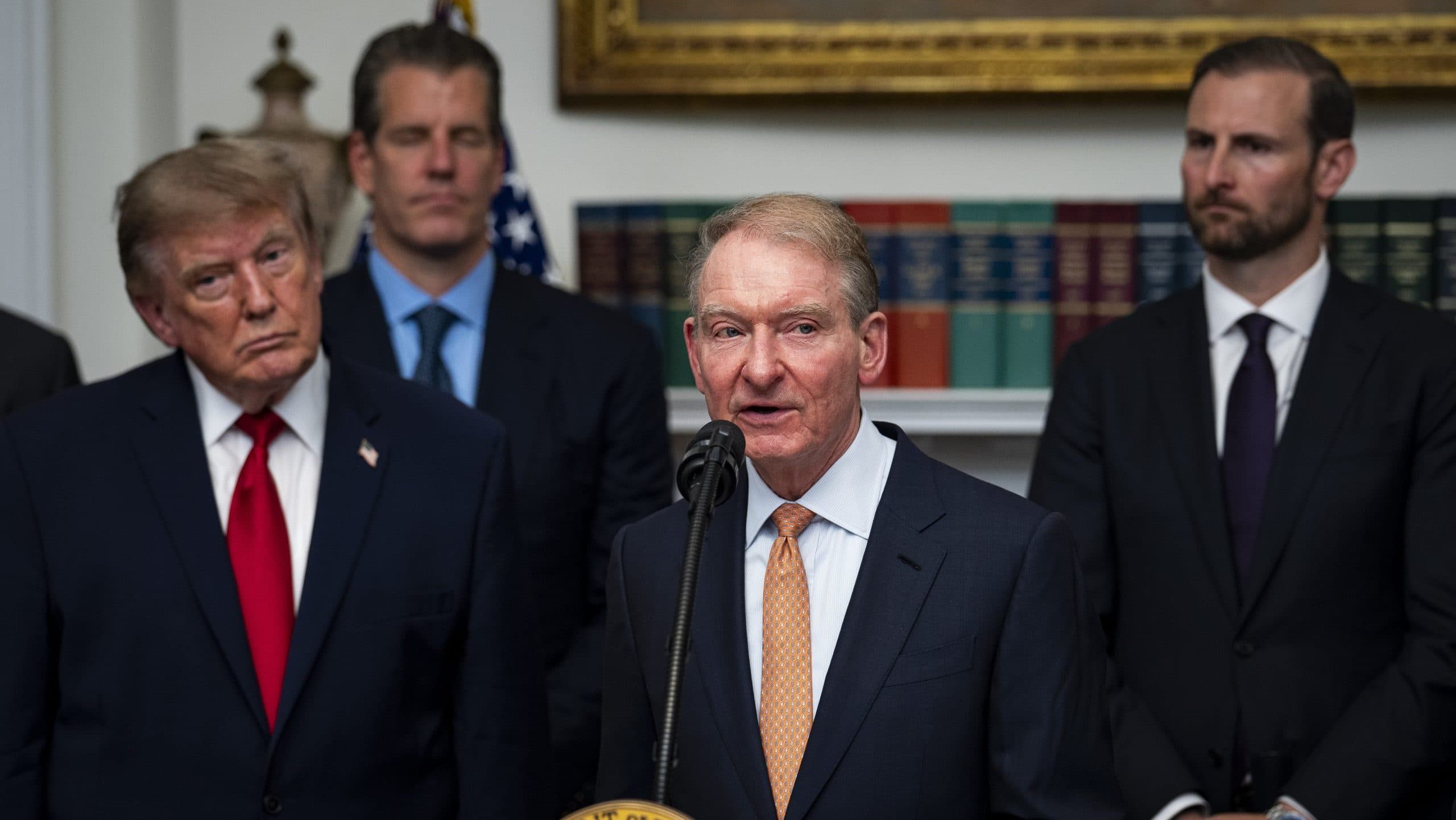
Six major blockchain organizations are calling on the US Securities and Exchange Commission (SEC) to make its classification of digital commodities part of binding crypto regulations. The proposal could affect how exchanges and investors handle tokens such as LINK, ADA, HBAR, APT, AVAX and XLM, particularly when these assets are traded on secondary markets.

 By John Isige
 BTC/USD rebounded last week and is now trading near its monthly highs around 65,400.00 as risk appetite improved amid renewed hopes for progress toward a US-Iran agreement and softer expectations for further Federal Reserve tightening.
 By John Isige
 Sui is integrating two NIST-standardized post-quantum signature schemes designed to protect user accounts and high-value vaults from future quantum-computing threats without forcing users to move assets or replace their existing recovery phrases.

 By Andrew Bennett
 The cryptocurrency market gave back part of this week’s rebound on Friday as traders turned cautious ahead of fresh US labour-market data and continued to follow developments around the Strait of Hormuz. At the time of writing, Bitcoin is trading near $64,900, Ethereum around $1,915, USDT close to $0.9992, BNB near $590, and USDC around $0.9999. Total crypto market capitalization stands at approximately $2.21 trillion, with Bitcoin dominance close to 59.0%. Institutional flows have remained supportive: over the four US trading sessions from August 3 through August 6, spot Bitcoin ETFs attracted a combined $763.6 million, while Ethereum ETFs recorded $194.1 million in net inflows.
 By John Isige
 The US Senate has pushed consideration of the CLARITY Act into September after lawmakers failed to reach the bipartisan agreement needed to move the landmark crypto market-structure bill before the August recess. The delay gives negotiators more time, but it also leaves one of the industry’s most important legislative efforts facing an increasingly tight political calendar.
 By Andrew Bennett
 Circle will launch the public mainnet of its Arc Layer-1 blockchain on September 16, bringing BlackRock, Visa, Mastercard and several other financial heavyweights into an unusually institution-led validator network.
 By John Isige
 Europe’s MiCA transition is creating confusion for customers of unauthorised crypto platforms — and scammers are already taking advantage of it. Regulators have reported cases in which criminals posed as financial watchdogs or legitimate crypto providers and used fake websites to persuade investors to transfer their assets to wallets controlled by fraudsters.
 By John Isige
 SOL/USD has been trending lower since last month. However, the pair has recently recovered part of its losses and is now trading near the middle Bollinger Band at 75.00, the Murrey [4/8] level. Overall, the chart resembles a Symmetrical Triangle pattern, which could break in either direction. If the price consolidates below the lower Bollinger Band at 71.88, the Murrey [3/8] level, the decline may continue toward 62.50, the Murrey [0/8] level, and 56.25, the Murrey [–2/8] level. However, a breakout above 78.12, the Murrey [5/8] level, could support a renewed advance toward 87.50, the Murrey [8/8] level, 93.75, the Murrey [+2/8] level, and 98.40, the area of the May highs.
 By John Isige
 Hashdex will close and liquidate its Bitcoin ETF, with trading scheduled to end on August 17. The move appears to mark the first shutdown of a US-listed spot Bitcoin ETF that directly holds BTC.
 By John Isige
 Ethereum researchers have proposed a major change to ETH issuance that would gradually burn a larger share of validator rewards as the staking ratio rises. The idea is not to impose a hard 50% staking cap, but to remove the protocol-level incentive for staking to keep expanding beyond that point.
 By Andrew Bennett
 Mastercard has completed its acquisition of BVNK for up to $1.8 billion, gaining stablecoin infrastructure that connects traditional payment systems with blockchain networks on a global scale.
 By John Isige
 Ethereum researchers have proposed burning a growing share of validator rewards in an attempt to prevent the staking ratio from rising indefinitely. The draft, known as EIP-8363, has already triggered a heated debate over validator economics, decentralisation and the possible consequences for DeFi.
 By John Isige
 Since late June, ETH/USD has been attempting an upward correction within a long-term downtrend. However, the price has now remained within the sideways range of 1937.50–1812.50, corresponding to the Murrey [7/8]–[5/8] levels, for more than three weeks. The prolonged slowdown in price growth may indicate that the upside potential is becoming exhausted. Nevertheless, a breakout above 2000.00, the Murrey [8/8] level and the middle Bollinger Band on the weekly chart, could support an advance toward 2125.00, the Murrey [+2/8] level, and 2500.00, the Murrey [4/8] level on the weekly chart. However, if the price consolidates below 1750.00, the Murrey [4/8] level, the decline may resume toward 1500.00, the Murrey [0/8] level, and 1375.00, the Murrey [–2/8] level.


For crypto, the framework is similar to traditional financial markets but comes with its own twist. Here, price action turns on liquidity, adoption, regulation, and flows from institutions alongside retail sentiment. Network health—hash rate, staking, active wallets—adds another layer. Macro still matters too: rates, dollar strength, and risk appetite shape inflows and outflows. Then, as with any market, you use the chart—trend, support and resistance, momentum, and volume—to spot setups and manage risk.