

The US dollar remains under pressure following weak July labour-market data. According to the US Bureau of Labor Statistics, the unemployment rate declined from 4.2% to 4.1%, while nonfarm payroll employment unexpectedly fell by 23,000 compared with economists' expectations for an increase of around 80,000. May and June payroll growth was also revised down by a combined 103,000 jobs, reinforcing signs that hiring conditions have softened.
Average hourly earnings were little changed in July, rising by just $0.02 to $37.62, while annual wage growth stood at 3.2%. The labour report prompted traders to reduce expectations for another Federal Reserve rate increase. CME FedWatch pricing put the probability of a 25-basis-point hike in September at around 44% immediately after the release, down from more than 50% beforehand. By August 10, the probability had recovered to roughly 48%, but remained well below the levels seen a week earlier.
Some economists nevertheless cautioned that the employment report does not necessarily rule out further monetary tightening. Inflation remains above the Federal Reserve's 2% target, and several Fed officials have indicated that higher rates could still be appropriate if price pressures remain persistent. The labour market is increasingly being described as a slow-hiring, low-layoff environment, leaving future policy decisions particularly dependent on incoming inflation data.
The euro is also receiving support from improving investor sentiment in the eurozone. The Sentix Investor Confidence Index rose from -3.1 points in July to 0.9 in August, returning to positive territory and reaching its highest level since February 2026. The current conditions component improved from -14.8 to -8.0, while the expectations index increased from 9.3 to 10.3. The improvement adds to the stronger eurozone indicators discussed in FORECK.INFO's recent EUR/USD outlook.
Geopolitical uncertainty surrounding the Middle East remains a potential restraining factor. Last week, US Treasury Secretary Scott Bessent said an arrangement that could allow more shipping through the Strait of Hormuz might be reached within days, but no final agreement followed. Iran and Oman have continued discussing a framework for new shipping lanes, while Tehran has linked a broader reopening of the strait to several US concessions.
US President Donald Trump said on August 9 that his administration was taking a restrained approach and watching economic pressure build inside Iran. At the same time, sanctions, military pressure and restrictions on maritime trade remain in place. Iran has demanded, among other conditions, sanctions relief, compensation and an end to military threats before a broader reopening of the Strait of Hormuz. Continued uncertainty over the key energy route could therefore keep oil prices volatile and remain a risk factor for European markets.
Support and Resistance Levels
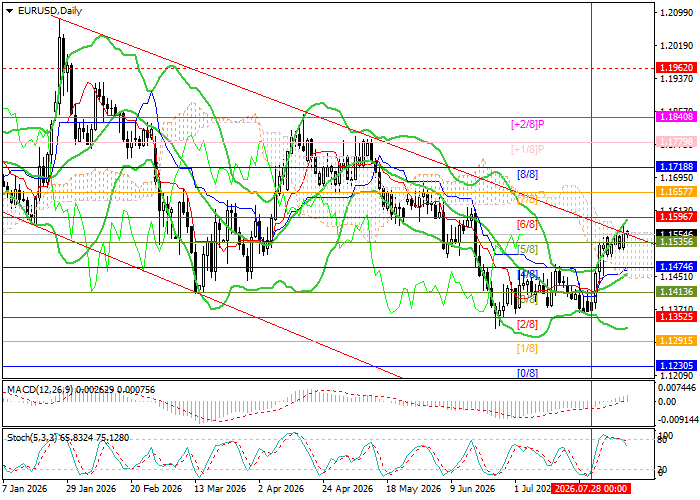
EUR/USD is attempting to break out of its descending channel through the upper boundary. A move above 1.1596, the Murrey [6/8] level, could allow the advance to continue toward 1.1718, the Murrey [8/8] level, followed by 1.1840, the Murrey [+2/8] level, and 1.1962 on the weekly chart. Conversely, consolidation below the middle Bollinger Band near 1.1474, the Murrey [4/8] level, could support a decline toward 1.1352, the Murrey [2/8] level, and 1.1230, the Murrey [0/8] level.
Technical indicators currently provide mixed signals. The Bollinger Bands are pointing higher, the MACD histogram has moved into positive territory, while the Stochastic Oscillator is turning lower from the overbought zone.
Resistance levels: 1.1596, 1.1718, 1.1840, 1.1962.
Support levels: 1.1474, 1.1352, 1.1230.
EUR/USD Trading Scenarios and Price Forecast
Short positions may be considered below 1.1474, with targets at 1.1352 and 1.1230 and a stop-loss at 1.1555. Time horizon: 5–7 days. Long positions may be considered above 1.1596, with targets at 1.1718, 1.1840 and 1.1962 and a stop-loss at 1.1520.
