

The reports supported assets considered alternatives to the US dollar. However, the positive momentum in GBP/USD remains fragile as investors await the Federal Reserve’s decision on Wednesday at 20:00 (GMT+2) and the Bank of England’s announcement on Thursday at 13:00 (GMT+2).
Most analysts expect the British regulator to keep Bank Rate unchanged at 3.75% and signal that the current monetary policy stance may remain in place over the medium term. A 25-basis-point increase in September remains possible, although it is not the market’s main scenario.
UK consumer inflation slowed from 2.8% to 2.6% year-on-year in June. Labour market data were mixed but relatively stable: the unemployment rate stood at 4.9% in the three months to May, while employment increased by 147,000 compared with the previous three-month period. Lower inflation supports a cautious approach from the Bank of England, although the improvement in employment limits the strength of the dovish signal.
Meanwhile, Federal Reserve officials could signal that higher borrowing costs may still be required later in the year, even though most analysts expect the target range to remain unchanged at 3.50–3.75% at the upcoming meeting.
US consumer inflation remained well above the regulator’s target despite slowing from a three-year high of 4.2% to 3.5% in June. Labour market figures were mixed: unemployment declined from 4.3% to 4.2%, while nonfarm payrolls increased by only 57,000. The data do not indicate a sharp deterioration in employment, but the modest payroll increase suggests that labour demand is no longer exceptionally strong. This combination leaves room for a more hawkish tone from the Fed in September or December without guaranteeing an interest rate increase.
Overall, the fundamental backdrop continues to support a moderately bearish outlook for GBP/USD, although the upcoming central bank decisions could trigger increased volatility.
Support and Resistance Levels
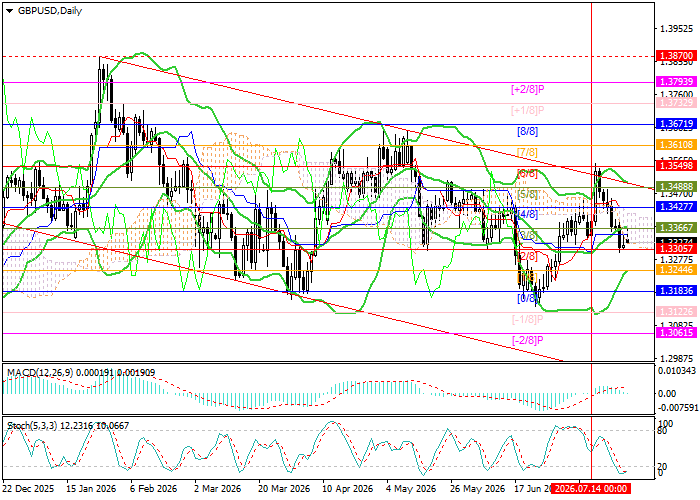
In the middle of the month, the trading instrument reached the upper boundary of the descending channel but failed to consolidate above it and reversed downward. The pair is now testing 1.3305 (Murrey level [2/8]), which was also highlighted in FORECK.INFO’s previous GBP/USD forecast focused on US labour market data.
A confirmed breakdown below 1.3305 could allow the pair to reach 1.3183 (Murrey level [0/8]) and 1.3061 (Murrey level [–2/8]).
Conversely, a breakout above 1.3488 (Murrey level [5/8]) could lead to an exit from the descending channel and support further gains toward 1.3671 (Murrey level [8/8]), 1.3793 (Murrey level [+2/8]) and the annual high of 1.3870.
Technical indicators do not provide a unified signal: the Bollinger Bands are turning upward, the MACD histogram is preparing to return to negative territory, while the Stochastic Oscillator has reached the oversold zone and may reverse upward.
Resistance levels: 1.3488, 1.3671, 1.3793, 1.3870.
Support levels: 1.3305, 1.3183, 1.3061.
GBP/USD Trading Scenarios and Exchange Rate Forecast
Short positions may be considered below 1.3305, with targets at 1.3183 and 1.3061 and a stop-loss at 1.3390. Implementation period: 5–7 days. Long positions may be considered above 1.3488, with targets at 1.3671, 1.3793 and 1.3870 and a stop-loss at 1.3400.
Scenario
| Timeframe | Weekly |
| Recommendation | SELL STOP |
| Entry Point | 1.3305 |
| Take Profit | 1.3183, 1.3061 |
| Stop Loss | 1.3390 |
| Key Levels | 1.3061, 1.3183, 1.3305, 1.3488, 1.3671, 1.3793, 1.3870 |
Alternative Scenario
| Recommendation | BUY STOP |
| Entry Point | 1.3488 |
| Take Profit | 1.3671, 1.3793, 1.3870 |
| Stop Loss | 1.3400 |
| Key Levels | 1.3061, 1.3183, 1.3305, 1.3488, 1.3671, 1.3793, 1.3870 |
