

July data pointed to a recovery in the UK private sector. The final S&P Global Manufacturing PMI eased from 52.5 in June to 51.9, below the preliminary estimate of 52.8, but remained in expansion territory. At the same time, the Services PMI rebounded from 48.8 to 52.1, while the Composite PMI climbed from 49.3 to 52.2, signalling the first expansion in overall private-sector activity since April.
The construction sector also showed signs of stabilisation. The Construction PMI jumped from 38.4 to 44.7, well above the 40.0 consensus forecast. Although the reading remained below the 50 threshold and therefore still pointed to contraction, the sharp improvement suggests that the downturn became less severe in July.
The stronger figures provide some support for sterling, although they are unlikely to remove uncertainty around the Bank of England’s next steps. An earlier GBP/USD outlook showed how quickly the pair has been reacting to shifts in domestic data and monetary-policy expectations.
The US dollar, meanwhile, remains supported near recent highs as investors assess developments in the Persian Gulf and wait for fresh US labour-market data. A proposed arrangement between Iran and Oman could eventually help restore more regular traffic through the Strait of Hormuz, but key terms remain unresolved and renewed tensions have prevented markets from treating an agreement as imminent.
Monetary policy is therefore becoming a more important driver for the dollar. Federal Reserve Governor Lisa Cook said inflation remains too high and that she would support a rate increase if necessary to return price growth to the 2.0% target. At the same time, she argued that it was appropriate to keep rates unchanged for now while policymakers assess whether recent disinflationary forces continue.
San Francisco Fed President Mary Daly also supported the latest decision to leave borrowing costs unchanged, saying that more data would be needed before the September meeting. The comments underline that the FOMC remains divided: another rate increase is possible, but it is not yet the base case confirmed by policymakers.
Support and Resistance Levels
On the daily chart, GBP/USD is correcting below the upper boundary of the 1.3150–1.3650 sideways channel.
Technical indicators continue to favour the bullish scenario. The fast EMAs of the Alligator indicator remain above the slower lines, while the Awesome Oscillator histogram is forming corrective bars in positive territory.
Resistance levels: 1.3500, 1.3650.
Support levels: 1.3400, 1.3270.
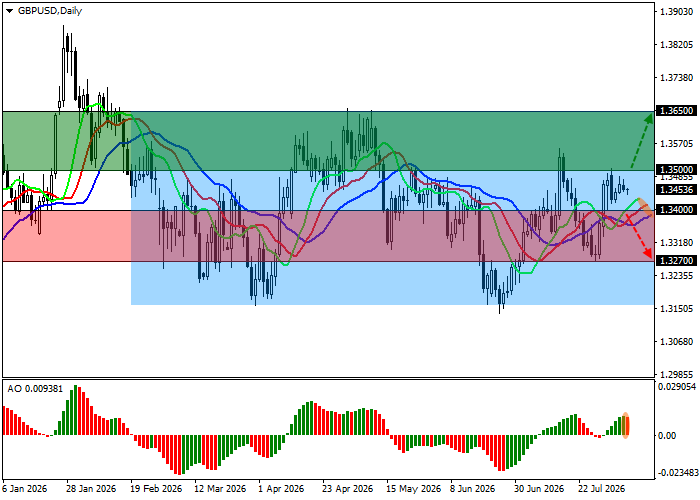
GBP/USD Trading Scenarios and Price Forecast
Long positions may be considered after the price rises and consolidates above 1.3500, with a target at 1.3650 and a stop-loss at 1.3420. Time horizon: seven days or more.
Short positions may be considered after the price falls and consolidates below 1.3400, with a target at 1.3270 and a stop-loss at 1.3500.
