

The yen continues to receive support from expectations that the Bank of Japan could accelerate monetary tightening. According to the BOJ's Summary of Opinions from its July 30–31 meeting, policymakers increasingly focused on upside risks to inflation. Several members argued that the Bank may need to raise rates more quickly than markets currently expect, while one view called for accelerating the adjustment of monetary accommodation if inflation risks materialize.
The BOJ kept its policy rate unchanged at 1.0% at the July meeting after raising it in June. The discussion also showed that some policymakers favour a more flexible approach rather than adhering to a predetermined pace of rate increases. One opinion stated that the Bank should discuss the size of future rate hikes and respond nimbly to changes in economic activity, prices, financial conditions and overseas developments.
The yen is also holding part of the gains generated by the recent currency intervention. In an official statement, Japan's Ministry of Finance confirmed that it purchased yen on July 31 in coordination with the U.S. Department of the Treasury. The ministry said the operation was intended to counter excessive volatility and disorderly movements in the currency and added that further coordinated intervention remains possible.
The move followed a prolonged period of yen weakness. FORECK.INFO had previously highlighted intervention risks when USD/JPY was trading near 162.00 in its USD/JPY outlook, as markets increasingly focused on the possibility of action by Japanese authorities.
On the US side, attention has shifted from Friday's weak labour-market report toward upcoming inflation data. According to the US Bureau of Labor Statistics, nonfarm payroll employment fell by 23,000 in July, while the unemployment rate declined to 4.1%. The July Consumer Price Index is scheduled for release on August 12 at 8:30 a.m. ET.
Expectations for the September Federal Reserve meeting remain finely balanced. The CME FedWatch Tool, which derives probabilities from Fed Funds futures, continues to show substantial uncertainty over whether policymakers will raise rates again or leave borrowing costs unchanged. A softer inflation report could weaken the case for additional tightening, while renewed price pressures could revive expectations for another increase.
Support and Resistance Levels
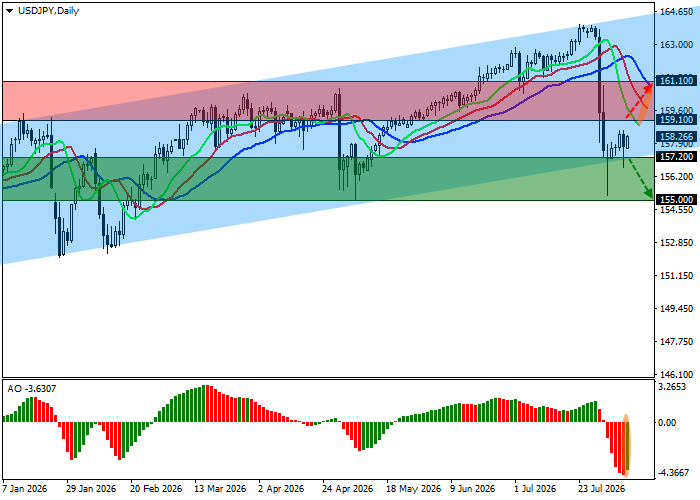
On the daily chart, USD/JPY remains within a corrective downtrend and is attempting to consolidate near the lower boundary of a channel with approximate limits at 164.50 and 157.00.
Technical indicators continue to provide a bearish signal. The faster moving averages of the Alligator indicator remain below the slower line, while the Awesome Oscillator histogram is forming corrective bars in negative territory.
Resistance levels: 159.10, 161.10.
Support levels: 157.20, 155.00.
USD/JPY Trading Scenarios and Forecast
Short positions may be considered after a decline and consolidation below 157.20, with a target at 155.00 and a stop-loss at 158.00. Time horizon: seven days or more.
Long positions may be considered after a rise and consolidation above 159.10, with a target at 161.10 and a stop-loss at 158.00.
