

The US dollar recovered moderately after the publication of July inflation data. According to the US Bureau of Economic Analysis, the headline personal consumption expenditures price index remained at 3.7% year-on-year, exceeding the 3.6% forecast, while core PCE held at 3.3%. Both indicators increased by 0.2% month-on-month and remain well above the Federal Reserve’s 2.0% target.
Persistent inflation supports the case for tighter monetary policy, although weaker labor-market and retail-sales data continue to argue for caution. Nonfarm payroll employment declined by 23.0 thousand in July, while retail and food-services sales fell by 0.6%. These factors were previously examined when weak US jobs data pushed EUR/USD toward 1.1596.
Following the PCE release, futures markets priced approximately a 40% probability of at least one 25-basis-point rate increase by the September meeting, around 54% by October and about 74% by December. Investors are now awaiting Federal Reserve Chair Kevin Warsh’s keynote address at the Jackson Hole Economic Policy Symposium on Friday, August 28. The speech may clarify how officials balance persistent inflation against softer employment data, although market participants do not expect a detailed policy commitment.
The European Central Bank may also maintain a hawkish stance. ECB Executive Board member Isabel Schnabel said borrowing costs must rise further because the continuing Middle East conflict, elevated energy prices and the resilience of the euro-area economy create additional inflation risks. Euro-area annual inflation reached 2.9% in July, while the core measure excluding energy, food, alcohol and tobacco stood at 2.5%.
Reuters sources also indicated that policymakers are leaning toward raising the ECB deposit rate from 2.25% to 2.50% at the September 9–10 meeting, although they have little appetite to signal additional tightening beyond that decision. Germany’s economy supports this cautious optimism: second-quarter GDP growth was revised to 0.3% quarter-on-quarter from the preliminary estimate of 0.2%, following growth of 0.4% in the first quarter. Annual GDP expanded by 1.0%, compared with the preliminary estimate of 0.9%.
Overall, the medium-term outlook for EUR/USD remains moderately positive, but further gains depend on the pair’s ability to consolidate above 1.1718 and on the tone of Warsh’s Jackson Hole speech.
Support and Resistance Levels
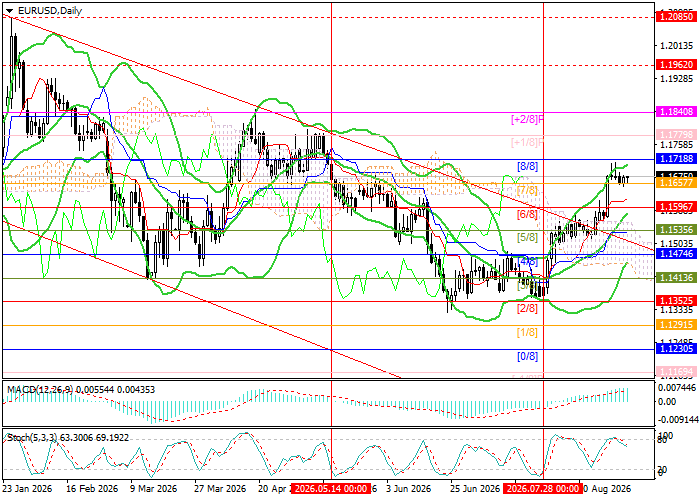
EUR/USD has broken above the upper boundary of the descending channel and is approaching 1.1718, the Murrey [8/8] level. A confirmed breakout and consolidation above this mark could open the way toward 1.1840, the Murrey [+2/8] level, followed by 1.1962, the weekly Murrey [6/8] level. Conversely, consolidation below the middle Bollinger Band at 1.1535, corresponding to Murrey [5/8], could return the pair to the descending channel and support a decline toward 1.1352 and 1.1230.
Technical indicators maintain a buy signal. The Bollinger Bands are directed higher and the MACD histogram is expanding in positive territory. At the same time, the Stochastic Oscillator is leaving the overbought zone, indicating the possibility of a limited correction.
Resistance levels: 1.1718, 1.1840, 1.1962.
Support levels: 1.1535, 1.1352, 1.1230.
EUR/USD Trading Scenarios and Price Forecast
Long positions may be considered above 1.1718, with targets at 1.1840 and 1.1962 and a stop-loss at 1.1630. Time frame: 5–7 days.
Short positions may be considered below 1.1535, with targets at 1.1352 and 1.1230 and a stop-loss at 1.1640.
Scenario
| Timeframe | Weekly |
| Recommendation | BUY STOP |
| Entry Point | 1.1718 |
| Take Profit | 1.1840, 1.1962 |
| Stop Loss | 1.1630 |
| Key Levels | 1.1230, 1.1352, 1.1535, 1.1718, 1.1840, 1.1962 |
Alternative Scenario
| Recommendation | SELL STOP |
| Entry Point | 1.1535 |
| Take Profit | 1.1352, 1.1230 |
| Stop Loss | 1.1640 |
| Key Levels | 1.1230, 1.1352, 1.1535, 1.1718, 1.1840, 1.1962 |
Conclusion: The bullish scenario remains valid while EUR/USD holds above 1.1535, but a confirmed break above 1.1718 is required to support further growth toward 1.1840 and 1.1962.
