
Trade tensions remain one of the main risks for the Canadian Dollar. The United States imposed 50% tariffs on C$27.6 billion worth of Canadian goods on August 22 after negotiations between the two countries collapsed. Canada responded with matching duties on the same value of US imports, which will take effect on September 8. Depending on the product category, the Canadian tariffs will range from 15% to 50% and cover steel, aluminium, dairy products, appliances, electronics, machinery, clothing and other goods.
For now, the impact of the tariff dispute has been partly offset by Canada’s stronger external accounts. According to Statistics Canada, the current account recorded a C$8.84 billion surplus in the second quarter, compared with a revised deficit of C$8.31 billion in the previous period. The result was more than twice the C$3.9 billion consensus forecast and marked Canada’s largest current-account surplus since the fourth quarter of 2005.
Goods exports increased by 13.1% to C$232.1 billion, led by a 27.4% rise in energy-product exports. Higher oil prices linked to disruptions in the Persian Gulf played an important role in the improvement. The continuing supply risks were examined in our latest WTI Crude Oil forecast.
Foreign direct investment into Canada also rose to C$25.9 billion from C$18.8 billion in the first quarter. The increase was driven mainly by foreign parent companies reinvesting earnings in their Canadian affiliates, while more than half of the total investment was directed toward manufacturing, finance and insurance.
The US Dollar Index is holding near 99.18 ahead of Federal Reserve Chair Kevin Warsh’s first Jackson Hole address, scheduled for 10:00 EDT on Friday. Warsh has so far preferred limited forward guidance, but investors will be watching for any indication of how the Fed intends to respond to inflation remaining well above its 2.0% target.
According to the CME FedWatch Tool, markets currently assign approximately a 33.7% probability to a 25-basis-point rate increase at the September meeting. The odds briefly rose above 40% after the latest PCE inflation report but have since returned to roughly one-third. The same monetary-policy uncertainty was recently discussed in our EUR/USD forecast following the US PCE release.
Support and Resistance Levels
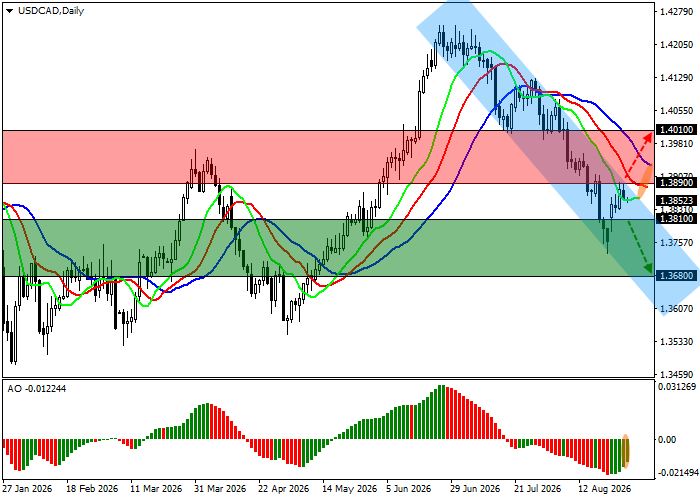
On the daily chart, USD/CAD is approaching the upper boundary of an ascending channel whose current range extends from approximately 1.3700 to 1.3850. The pair’s inability to consolidate above this area increases the risk of a downward correction.
Technical indicators are strengthening their sell signal. The Alligator lines have moved into a bearish configuration and are beginning to widen, with the faster lines remaining below the slower one. The Awesome Oscillator is also forming corrective bars in negative territory.
Support levels: 1.3810, 1.3680.
Resistance levels: 1.3890, 1.4010.
USD/CAD Trading Scenarios and Price Forecast
Short positions may be considered after the price breaks and consolidates below 1.3810, with a target at 1.3680 and a stop-loss at 1.3900. Time frame: seven days or longer.
Long positions may be considered after the price breaks and consolidates above 1.3890, with a target at 1.4010 and a stop-loss at 1.3810.
Scenario
| Timeframe | Weekly |
| Recommendation | SELL STOP |
| Entry Point | 1.3810 |
| Take Profit | 1.3680 |
| Stop Loss | 1.3900 |
| Key Levels | 1.3680, 1.3810, 1.3890, 1.4010 |
Alternative Scenario
| Recommendation | BUY STOP |
| Entry Point | 1.3890 |
| Take Profit | 1.4010 |
| Stop Loss | 1.3810 |
| Key Levels | 1.3680, 1.3810, 1.3890, 1.4010 |
